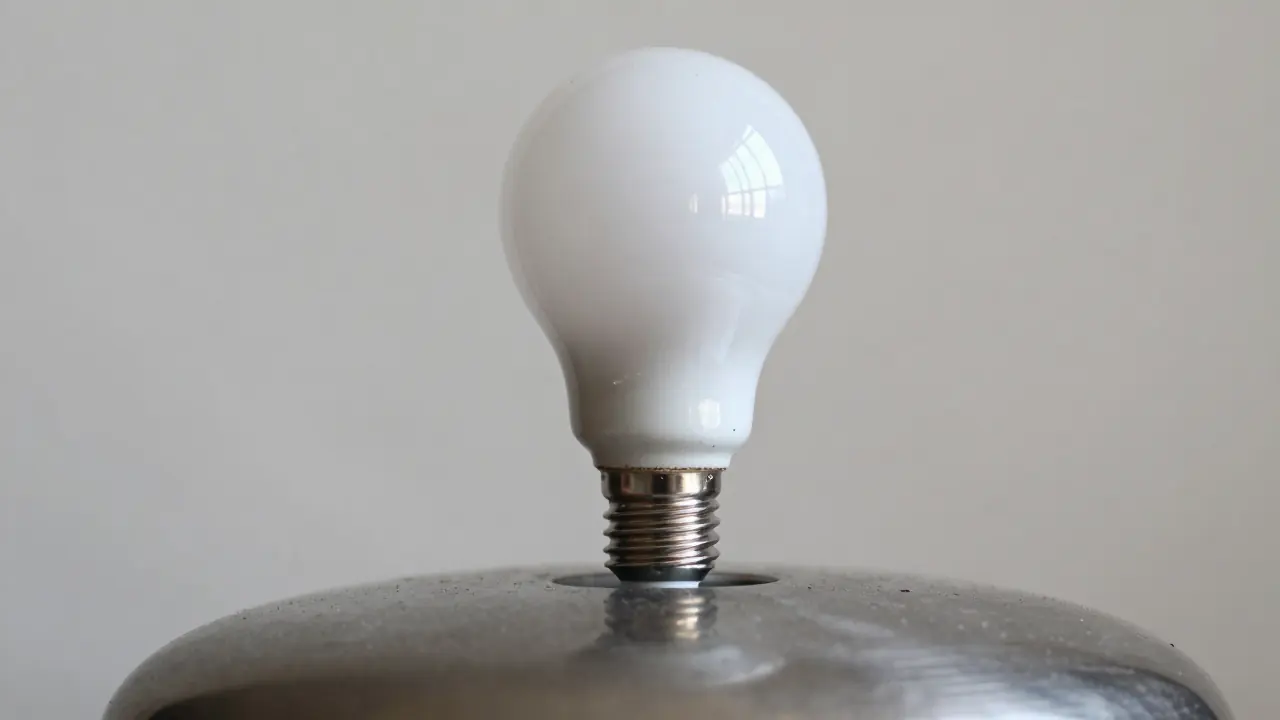
A ceramic heat emitter (CHE) is a screw-in ceramic element that gives off heat and no light. It warms the air in a reptile enclosure, so it suits night heat and ambient warmth, not a bright basking spot. Always run it on a thermostat, in a ceramic socket, inside a fixture rated for the wattage.
A CHE runs very hot, roughly 200 to 500°F (95 to 260°C) at the element, so treat it like a fire risk. Use a ceramic socket and a metal or ceramic dome rated for the wattage, never a plastic fixture. Keep a wire guard so your animal cannot touch it, and keep cords and water apart. Run it from a thermostat, check temperatures with a digital probe or infrared temperature gun, buy UL-listed equipment, and unplug before reaching in.
What a ceramic heat emitter is
A CHE looks like a light bulb with no glass, a solid ceramic dome that glows with heat but not with light. It screws into a standard ceramic socket. Because it makes no visible light, it can run day and night without disturbing a reptile’s sleep. Many keepers use one for a steady baseline temperature, and then add a separate light for daytime if the species needs it. Wattages are commonly 50, 60, 80, 100 and 150, and small “nano” versions in the low tens of watts exist for little enclosures.
How it heats
A CHE emits long-wave infrared (IR-C). That energy is absorbed mostly at the surface, and the emitter warms the air and objects around it more than it heats deep into an animal’s body. Some makers call it deep-penetrating, but the more common view among keepers is that it raises ambient temperature and a gradient, while a deep heat projector does the surface-and-below basking job. Treat marketing claims with caution and let the thermometer decide.
One side effect: CHEs can dry out an enclosure fast. Humidity-loving species may need extra misting or a different heat source.
Choosing wattage
There is no single right wattage. It depends on enclosure size, room temperature and how far the emitter sits from the animal. As a rough starting point, a small enclosure uses about 50 to 75 watts, a medium one 75 to 150, and a large enclosure or a cold room 150 to 250 or more. With a thermostat, it is safer to choose a slightly stronger unit and let the controller back off than a weak one that never reaches the set point.
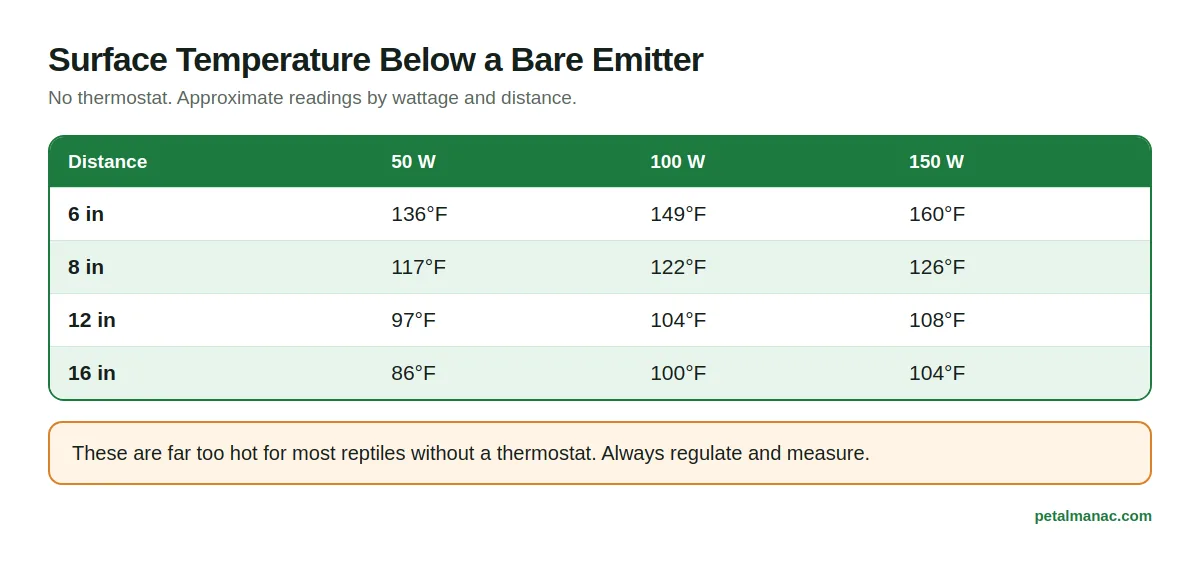
Distance matters just as much. One maker’s chart for a bare emitter shows how steeply the surface under it drops with height.
| Distance below the emitter | 50 W | 100 W | 150 W |
|---|---|---|---|
| About 6 in (150 mm) | 136°F | 149°F | 160°F |
| About 8 in (200 mm) | 117°F | 122°F | 126°F |
| About 12 in (300 mm) | 97°F | 104°F | 108°F |
| About 16 in (400 mm) | 86°F | 100°F | 104°F |
These are surface temperatures on slate with no thermostat, so they show how fast heat falls off with distance, not what to aim for in your tank.
Fixture, dome and guard
- Ceramic socket only. A plastic socket can melt. Match the socket to the emitter’s wattage.
- Dome. Use a reflective dome that is rated for CHEs, because some are not.
- No ballast. Most CHEs do not need one.
- Enclosure materials. Glass, PVC and melamine tolerate radiant heat. Place the emitter so it does not touch plastic, wood or mesh that can melt or burn.
- Guard. Fit a cage guard if the emitter is inside the enclosure, and mount it outside whenever you can.
- Cords. Make a drip loop so water cannot run along the cable to the outlet.
You must use a thermostat
A CHE has no built-in off switch. Without a thermostat it can keep heating until the enclosure is dangerously hot. Use a dimming thermostat or a pulse-proportional one, which reduces the power instead of cutting it hard. An on/off thermostat switches the element completely on and off and is a poorer match, so most keepers prefer proportional. Put the probe at the animal’s level in the warm zone, not on the lamp itself.
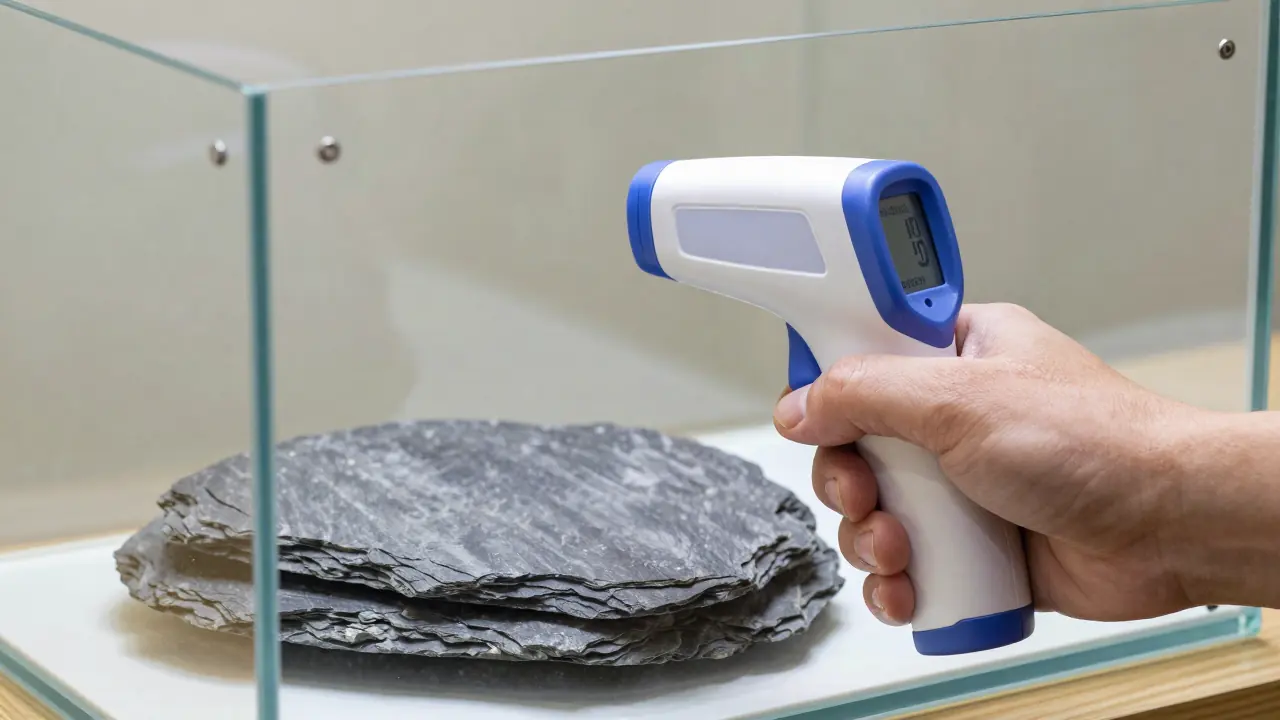
Dial it in, then confirm. Read the warm side with a temperature gun and a second probe thermometer, and check the cool end too. Always keep a gradient. Our reptile heating guide explains zones and target ranges, and leopard gecko heat and lighting shows how this works for one species.
Placement
Mount the emitter on one side so the far end stays cooler. Aim it over a flat rock or slate. Keep it clear of the substrate, branches and anything flammable, and out of reach of climbing animals. Keep enough height that the animal cannot sit against it. Heat falls off with distance, so raising or lowering the dome is a quick way to tune the warm side.
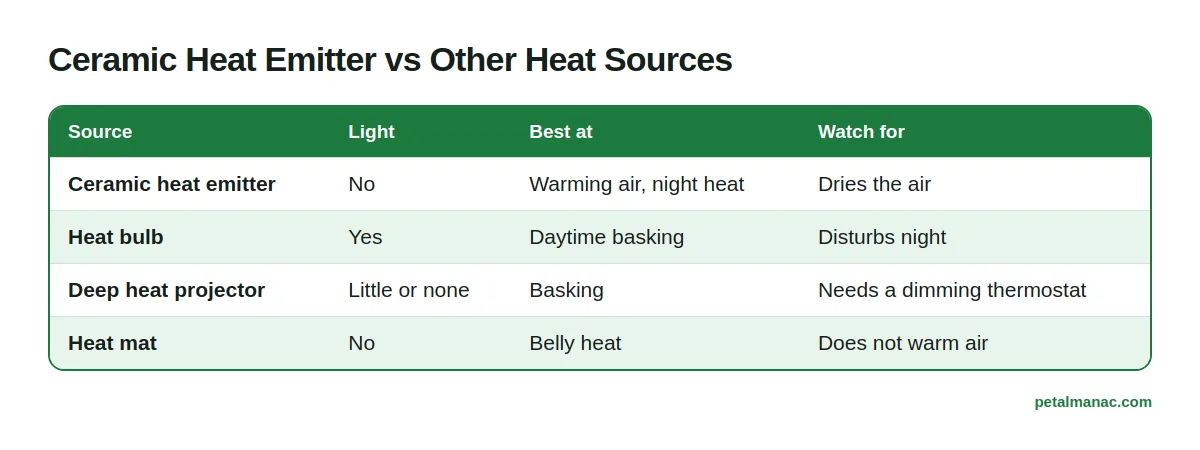
CHE vs heat bulb vs deep heat projector vs heat mat
| Option | Gives light? | Best at | Watch for |
|---|---|---|---|
| Ceramic heat emitter | No | Warming the air, night heat, large enclosures | Dries air, needs thermostat and ceramic socket |
| Basking heat bulb | Yes | A bright daytime basking spot | Light at night can disturb sleep, so it is a daytime tool |
| Deep heat projector | Little or none | Basking and deeper heat from a small spot | Not ideal for room-wide air warmth, needs dimming thermostat |
| Heat mat | No | Gentle belly heat for small, ground-dwelling species | Does not warm the air, needs a thermostat |
Pros and cons
Pros: no light, so it works at night; durable; screws into a common socket; good for large enclosures; makes a clean gradient.
Cons: mostly heats air, not the animal; can dry out the enclosure; needs a ceramic socket; runs hot and is fragile if dropped; useless without a thermostat.
Can you leave it on all the time?
Yes, on a thermostat. A CHE is made for round-the-clock use because it gives off no light, so it can hold a night temperature while lights go off. Let the thermostat set a lower night target, and make sure the temperature never falls outside what the species needs. Check the readout and the animal daily.
Lifespan
CHEs are durable. One maker rates its nano emitter for up to 5 years, and they last long when used properly. They will not blow out like a filament bulb, so a failed one often just stops warming. If the enclosure is cooler than the thermostat says it should be, read the temperature at the emitter, check the socket and replace it.
Which reptiles suit a CHE?
Nocturnal and crepuscular species, such as small geckos, and any animal in a large enclosure that needs ambient warmth. Tortoise setups are another common use. For daytime baskers, pair the emitter with a bulb or a heat projector. If you are unsure, read the care guide for your animal, such as leopard gecko care. More equipment walkthroughs live in our How-To section. If an animal looks unwell from heat or cold, contact an exotic veterinarian.
FAQ
Does a ceramic heat emitter give off light?
No. It produces heat only, which is why it works at night.
Can I use a ceramic heat emitter without a thermostat?
No. Without a thermostat the enclosure can overheat. Use a dimming or pulse-proportional unit.
What wattage should I buy?
It depends on enclosure size, room temperature and mounting height. Start from the rough ranges above and tune with a thermostat and a temperature gun.
Can a ceramic heat emitter replace a heat lamp?
For night heat and air warmth, yes. For a bright daytime basking spot with UV, no.

The Pet Almanac editorial team researches, writes and edits every care guide on the site. Each guide is fact-checked before publishing and reviewed again when care guidance or equipment changes.