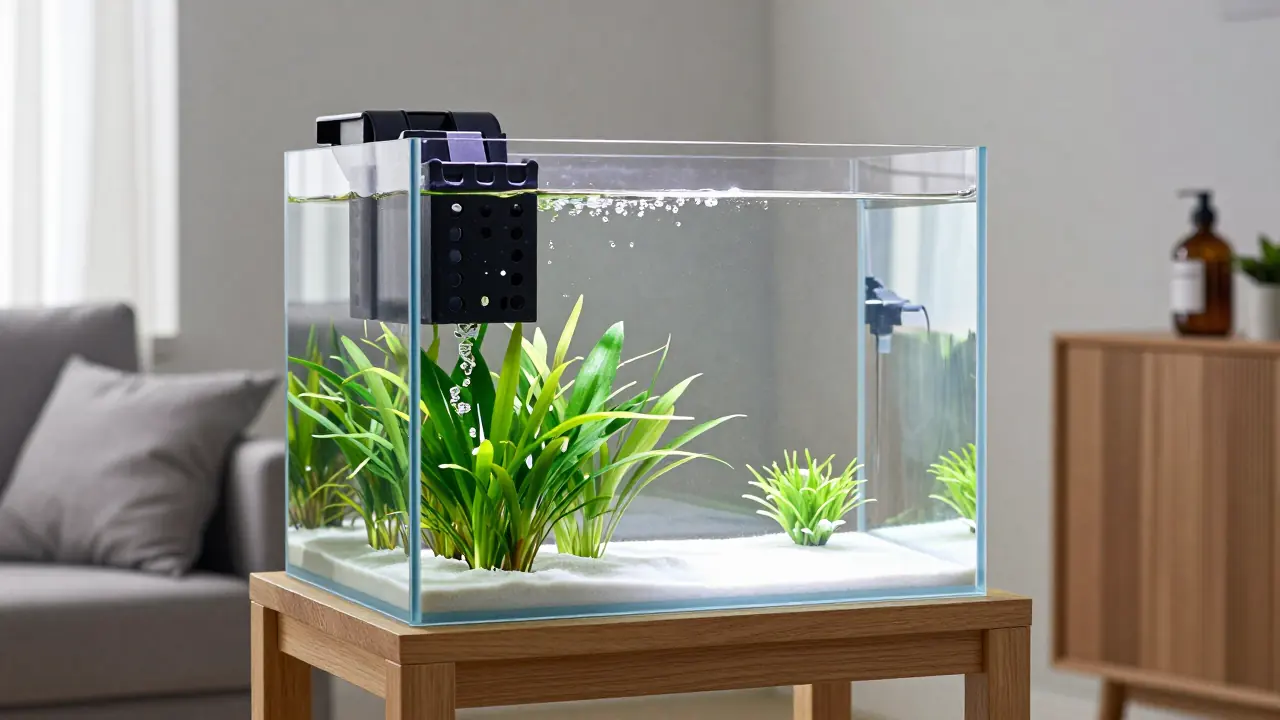
The main aquarium filter types are hang-on-back (HOB), sponge, canister, internal and undergravel filters. For most beginners the hang-on-back filter is the easy default: it is the most common type, it works on all but the largest tanks, and the media is simple to rinse. Sponge filters suit small and breeding tanks, and canisters suit larger tanks with heavy stocking.
Whatever you choose, a filter does three jobs, and good filtration means all three are covered. The sections below explain how each type works, then cover the HOB in detail, since it is the one most keepers start with.
The three kinds of filtration
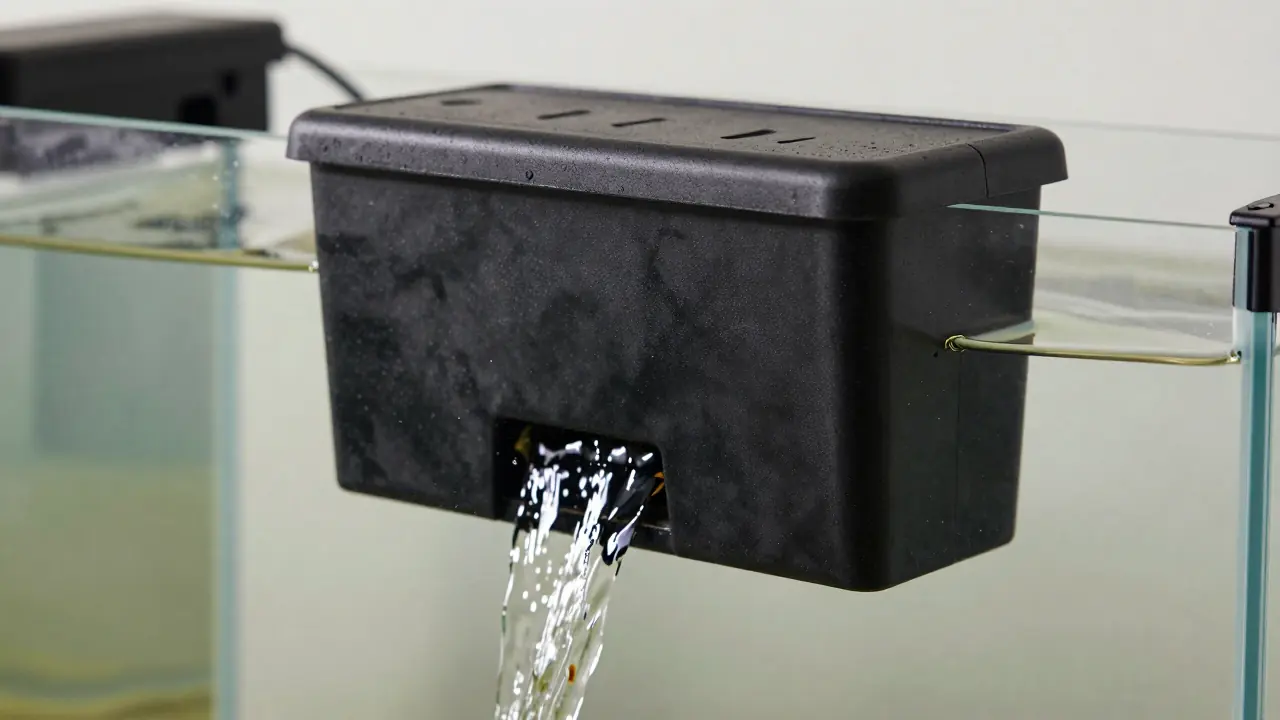
Mechanical, biological and chemical filtration are jobs a filter does, not separate machines. Most filters combine them in layers of media.
- Mechanical: traps solid waste such as fish waste, uneaten food and plant debris as water passes through foam, floss or a sponge.
- Biological: uses nitrifying bacteria, which live on porous media with lots of surface area, to convert ammonia to nitrite and then to nitrate. Without it, ammonia rises to levels that harm fish. Read the fish tank cycling guide to see how the bacteria colony grows.
- Chemical: removes dissolved waste, odors and discoloration, usually with activated carbon. Carbon is optional, and it also pulls fertilizers and treatments out of the water, so take it out before dosing.
Aquarium filter types compared
| Filter type | Filtration it does best | Tank size | Maintenance | Main drawback |
|---|---|---|---|---|
| Hang-on-back (HOB) | Mechanical, some chemical, limited biological | Small to large; two can run on bigger tanks | Easy; rinse media | Little biological media in most models |
| Sponge | Biological and mechanical | Small tanks and breeding tanks | Very low | Visible in the tank; weak circulation in large tanks |
| Canister | All three, under pressure | Larger tanks, over about 30 gallons | Higher; more parts | Cost and complexity |
| Internal | Mechanical, biological, some chemical | Small tanks, quarantine setups | Easy | Takes space inside the tank |
| Undergravel | Biological, whole substrate | Many sizes, gravel only | Gravel vacuuming | Not usable with sand or soil |
Hang on back filter: how it works
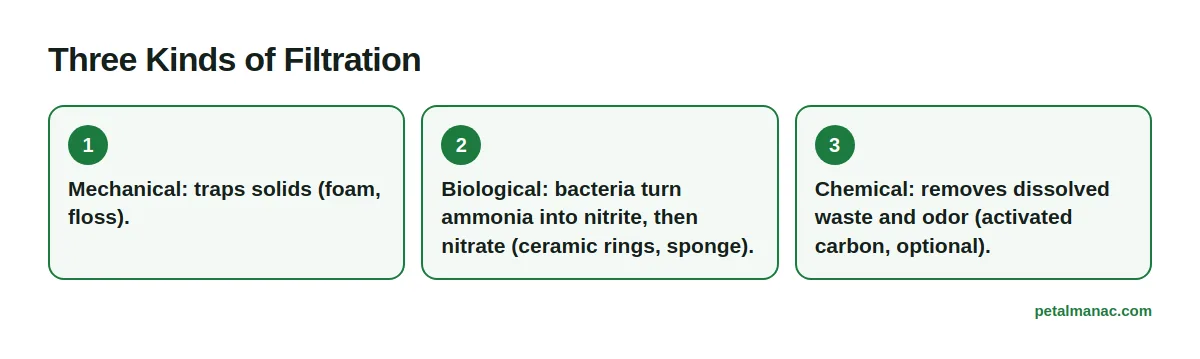
A HOB filter hangs on the rim of the tank, usually at the back. A pump or impeller pulls water up an intake tube, pushes it through a tray or cartridge of media, and returns it to the tank over a spout. It is an external design, so the pump and the media sit outside the water and are easy to reach for cleaning.
Most HOBs use back-to-front flow, where water passes through a cartridge or media tray. Some larger models use bottom-to-top flow, which pushes water up through trays of media and works more like a small canister. Bottom-flow units hold more media, so they handle more bacteria, as long as the media is cleaned rarely.
Hang-on-back pros and cons
- Pros: the most common filter type; easy to install and clean; works on a wide range of tank sizes; excellent mechanical filtration; doesn’t take up room in the tank; you can run two on a larger tank.
- Cons: most models hold very little biological media, perhaps half an ounce at most in a cartridge; the smooth water sheet at the outlet adds little aeration; cleaning it too aggressively removes the bacteria that it does hold.
Because the biological capacity is small, a HOB is best on lightly stocked tanks. For a heavier load, add a sponge filter alongside it or step up to a canister.
How to set up a HOB filter
- Rinse new media in plain water briefly. Avoid soap.
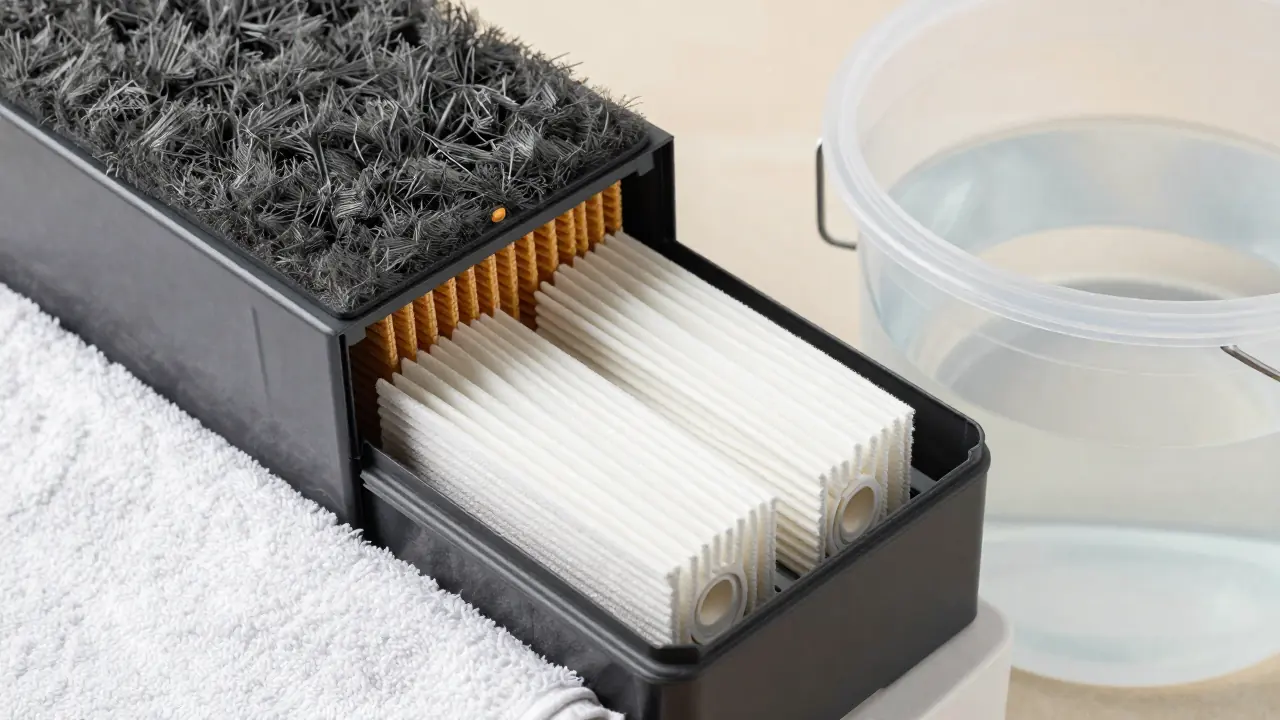
- Load the media in order. Coarse sponge goes first so it catches big particles, then fine floss, then biological media. Carbon, if used, goes in the cartridge or tray with it.
- Hang the unit on the back rim and adjust the intake tube so it reaches below the water line.
- Fill the reservoir with tank water so the impeller can prime.
- Run the cord through a drip loop and plug the filter in. Confirm that water is flowing steadily from the spout.
Filters, heaters and lights are electrical. Use UL-listed equipment, make a drip loop in every cord, plug into a power strip mounted above the water, and unplug the filter before putting hands in the tank. A heater should always run through a thermostat, and tank temperature should be checked with a digital probe thermometer.
HOB filter maintenance
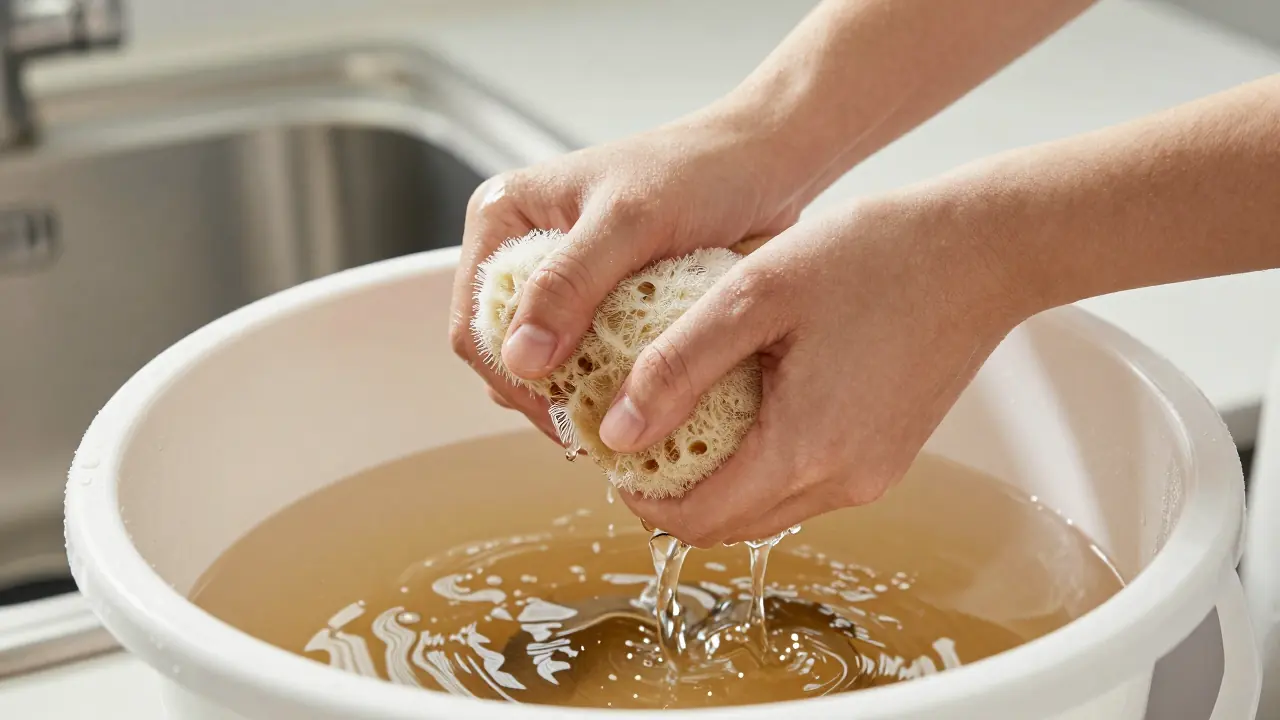
Rinse the media in a bucket of old tank water, never under the tap. Chlorine in tap water kills the bacteria on the media, which can disrupt the nitrogen cycle. Mechanical foam or floss is typically rinsed or replaced every 2 to 4 weeks, depending on how much waste is in the tank.
Manufacturers tell you to replace cartridges about once a month. Many experienced keepers disagree: the brown gunk on a cartridge is mostly beneficial bacteria, replacing the cartridge throws them away, and cartridges can last for years if you brush off the face when flow slows. A good compromise is to swap the cartridge for foam, squeeze it gently no more than twice in a bucket of old tank water every week or two, and never replace everything at once. If you change cartridges, rinse the old one in a few cups of tank water and pour it into the new filter to seed it.
Upgrading a stock HOB is easy. Replace the cartridge with a block of coarse foam of about 20 to 30 pores per inch, leave at least a quarter inch of free space behind it so water flows over the whole face, and add a 20 ppi foam piece to the intake. Plastic pot scrubbers also work and clog less than foam. A bio-wheel adds a little aeration, though it can stick.
Sponge filters
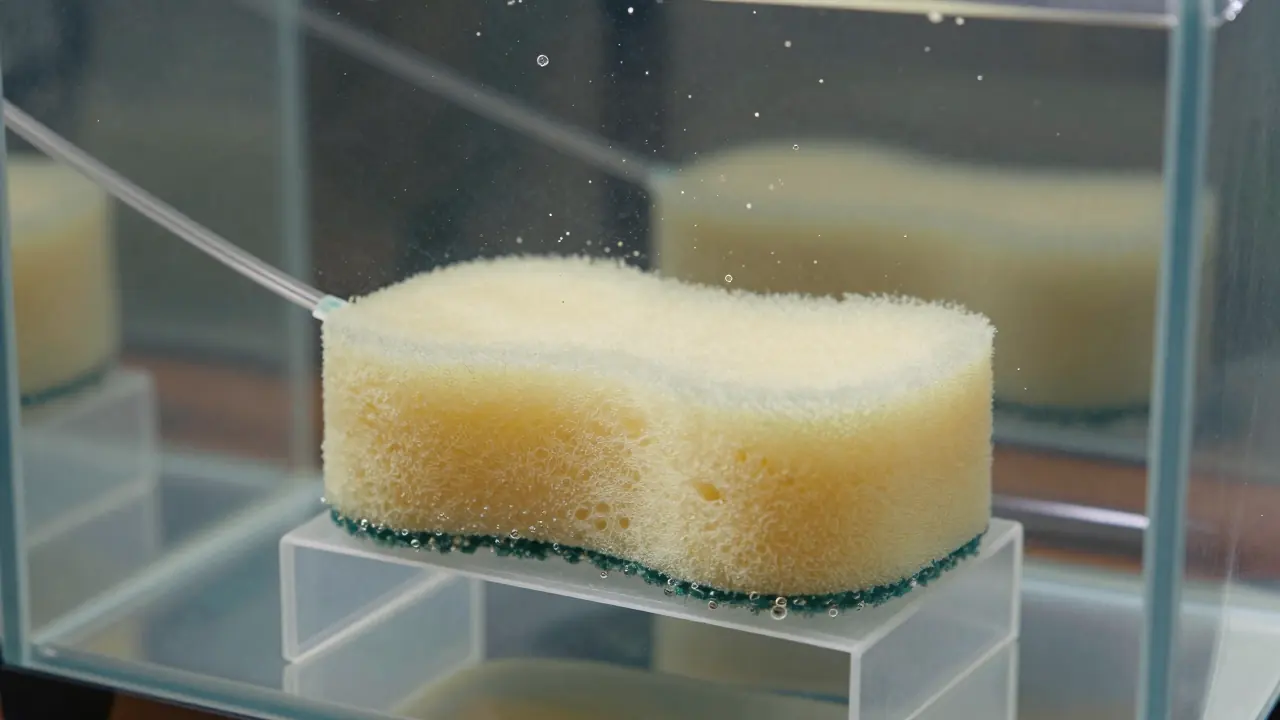
A sponge filter is a foam cylinder or block that sits in the tank and runs from an outside air pump. The air bubbling up an internal tube pulls water through the foam, catching debris and giving bacteria a huge surface. It is the simplest filter, gentle on the fish, and ideal for small tanks and breeding setups. In larger tanks it may not move enough water on its own. You can see the sponge in the tank, which some people dislike.
Canister filters
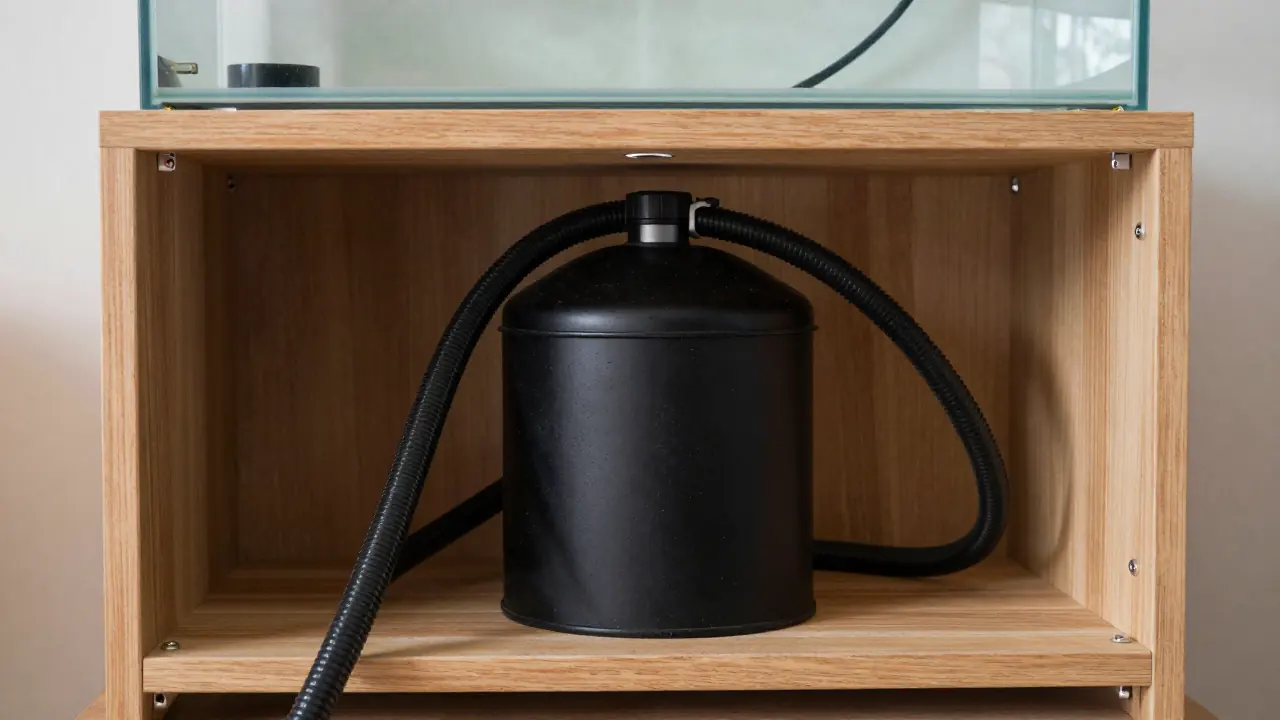
A canister is a pump-driven sealed barrel that usually sits in the aquarium stand, with only the intake and return pipes visible in the tank. It holds a large volume of mechanical, biological and chemical media, and pushes water through under pressure. That power suits larger tanks (over about 30 gallons) with a lot of fish, but it costs more and has more to take apart when you clean it.
Internal and undergravel filters
Internal filters are small submerged units, suited to small tanks and quarantine setups. They combine mechanical and biological filtration.
An undergravel filter is a plate under the gravel with uplift tubes. Water is pulled down through the gravel, so the whole floor becomes a biological filter. It needs gravel of about 5 mm or larger and cannot be used with sand or soil. It is cleaned by vacuuming the gravel. If you want sand or aqua soil, pick a different filter, and see the substrate guide before you commit.
How strong should a filter be?
Aim for a filter rated to turn over the tank volume 4 to 6 times per hour. A 20-gallon tank needs a filter of about 80 to 120 gallons per hour. Larger tanks are better served by a larger unit or two smaller filters. More flow is not always better. Strong current stresses some fish, so match the flow to what you keep. Delicate swimmers such as bettas prefer gentle flow, as covered in the betta tank setup guide. Find your tank’s volume in the fish tank sizes chart.
Filter not working or noisy: troubleshooting
- HOB not working: check that it is plugged in and that the water level is above the intake. Then clean the intake and impeller, since debris or a cracked impeller stops the pump. Refill the reservoir if it will not prime.
- HOB gurgling or loud: a low water level lets the intake pull air. Top the tank off and reseat the unit. A dirty impeller can also rattle.
- Air pump noisy: set it on a soft surface, keep it level and above the water line, and check for a worn diaphragm or a loose tube.
- Flow slowing: the media is clogged. Rinse it in tank water.
- Cloudy water after cleaning: too much media was cleaned or replaced at once, so give the tank time to recover.
A working filter should leave the water clear and free of odor. Checking ammonia and nitrite with a liquid kit shows whether biological filtration is keeping up.
Frequently asked questions
What are the different types of aquarium filters?
Hang-on-back, sponge, canister, internal and undergravel filters are the main ones.
What are the three main types of filtration?
Mechanical (traps solids), biological (bacteria process ammonia) and chemical (removes dissolved waste, usually with carbon).
What type of aquarium filter is most effective?
It depends on tank size and stocking. A canister has the most media and the most capacity for large tanks. A sponge filter holds far more biological media than a typical HOB cartridge.
Can I use more than one filter?
Yes. Two filters add backup and extra capacity and create more varied flow.
Can I over-filter a tank?
You can’t really have too much filtration, but too much current can stress some fish.

The Pet Almanac editorial team researches, writes and edits every care guide on the site. Each guide is fact-checked before publishing and reviewed again when care guidance or equipment changes.