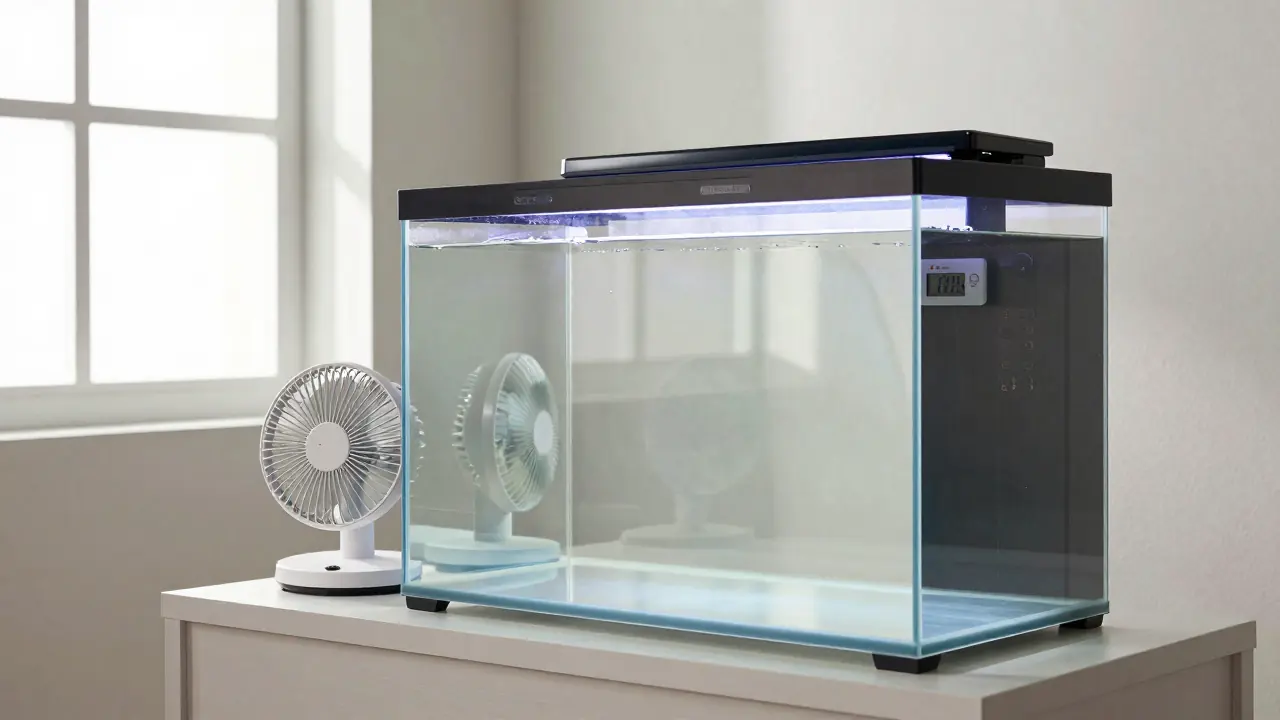
To cool down a fish tank, take off the lid, point a fan across the water surface, turn the lights off and cool the room. If the tank is too cold, the fix is the opposite: a correctly sized heater on a controller. Either way, change temperature slowly, because a sudden swing hurts more than a few degrees off target.
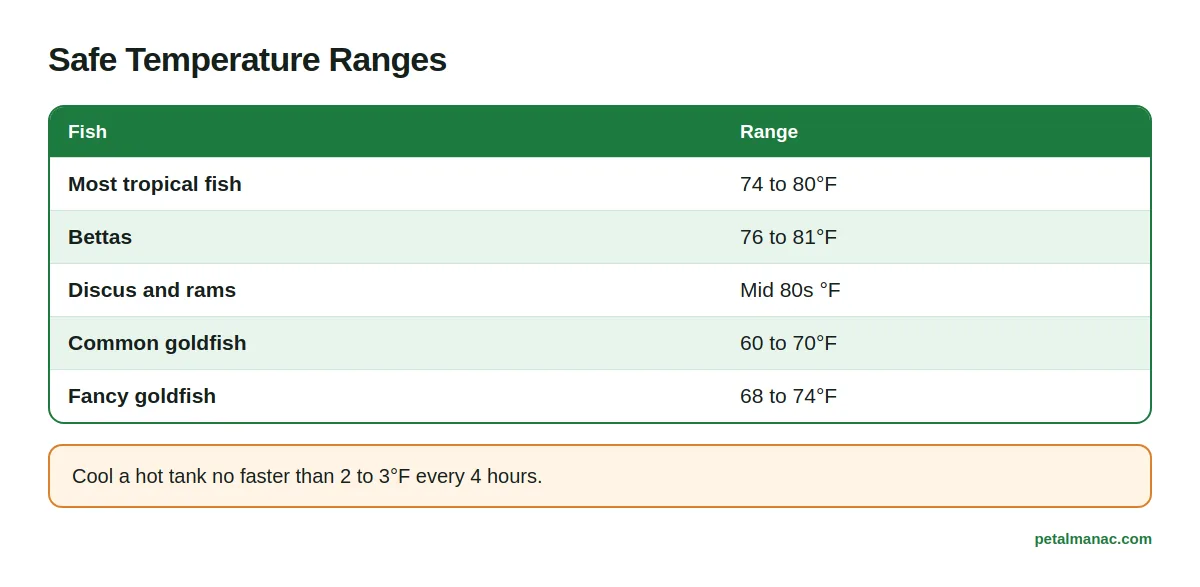
What temperature should the tank be?
Most tropical fish prefer 74 to 80°F (23 to 27°C). Bettas sit near the top of that range at 76 to 81°F, and a few species such as discus and rams are kept warmer still, in the mid 80s. Cold-tolerant fish need less: common goldfish prefer 60 to 70°F, and fancy goldfish 68 to 74°F. Check your species before you decide the tank is too hot or too cold.
Read the temperature with a digital probe thermometer placed away from the heater, not a stick-on strip.
Too hot: signs and why it matters
Warm water holds less dissolved oxygen, so a hot tank is also a low-oxygen tank. The classic sign is rapid gill movement or gasping at the surface. Heat also speeds up fish metabolism and waste output, which pushes ammonia up (see how to lower ammonia). Saltwater holds even less oxygen than freshwater at the same temperature.
How to cool down a fish tank fast
Work from the easy, free steps toward equipment.
- Remove heat sources. Turn the lights off or reduce the photoperiod, close curtains and move the tank out of direct sun.
- Turn the heater down, but not off. If it is a hot day the heater is probably idle already. Lowering the setting stops it from fighting you.
- Open the tank. Take off a glass lid and swap it for a screen top or leave it partly open. Open the cabinet doors under the stand so heat from the pump or filter can escape.
- Add a fan. Aim a small fan across the surface. Evaporation can drop the temperature by a few degrees. Lower the water level by an inch or two to deter jumpers.
- Increase surface agitation. More surface movement helps the water give up heat and take in oxygen.
- Cool the room. Air conditioning or moving the tank to a cooler room is the biggest single change you can make.
Frozen bottles, carefully
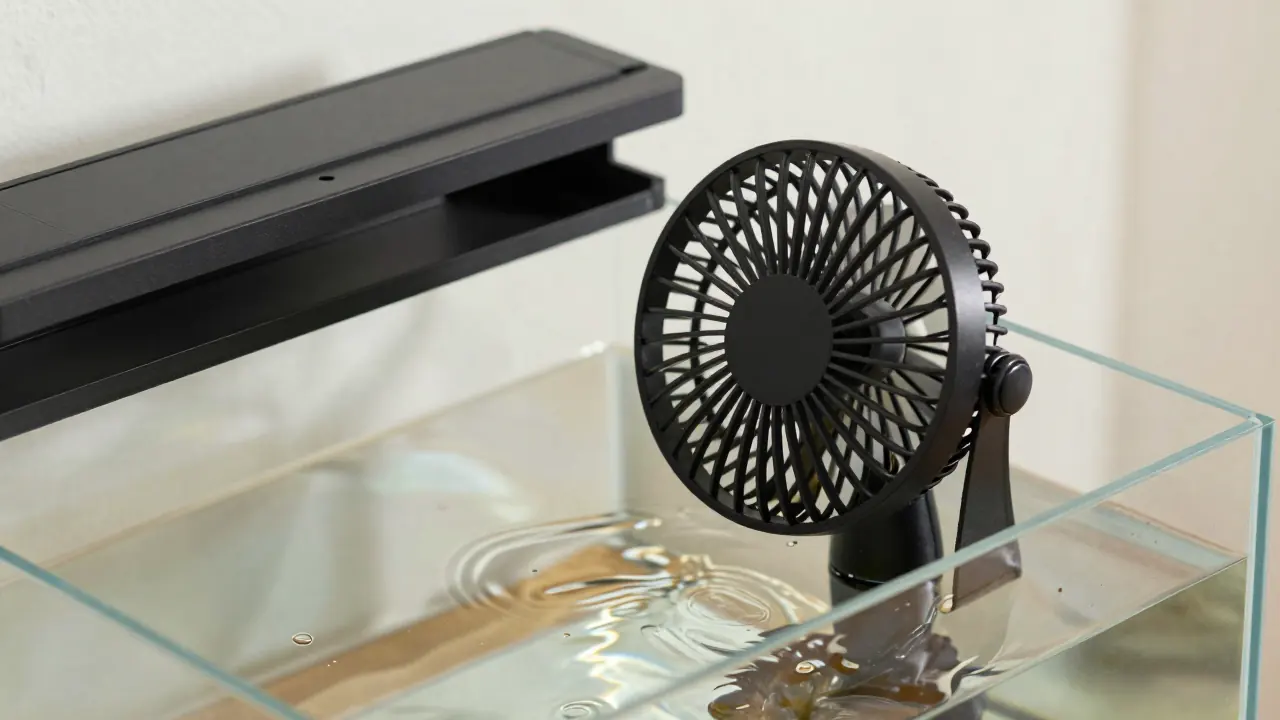
You can float sealed, clean bottles of frozen water or ice packs in the tank. Replace them often, and keep them sealed so nothing leaks into the water. Ice cubes dropped in directly are fine only if made from dechlorinated or RO water, and they melt unevenly, so avoid them if you can.
Longer-term cooling
- Insulate. Foil-faced bubble wrap or foam sheets stuck to the back and sides can drop the temperature by a few degrees.
- Move the tank. Upper shelves run several degrees warmer than lower ones.
- Switch to LED lights. Older fixtures like T5s and metal halides add heat.
- Use DC pumps. They put less heat into the water than AC pumps.
- Add a chiller. A chiller is the dependable fix for a tank that overheats every summer. It is a major expense, and it needs a correctly sized unit and a controller. It is mostly worth it for large or sensitive tanks.
Fans and evaporation raise your top-off needs, so watch the water level daily, or add an auto top-off system. Add a battery-backed USB fan if you worry about power cuts.
What not to do
- Do not drop the temperature fast. Avoid cooling by more than 2 or 3°F in a 4-hour period. A sudden, drastic drop can bring on parasites.
- Do not dump in ice or a big cold water change. Cold tap water also carries chlorine. If you must change water, use dechlorinated water only a little cooler than the tank. See our water conditioner guide.
- Do not switch the heater off completely if nights are cold.
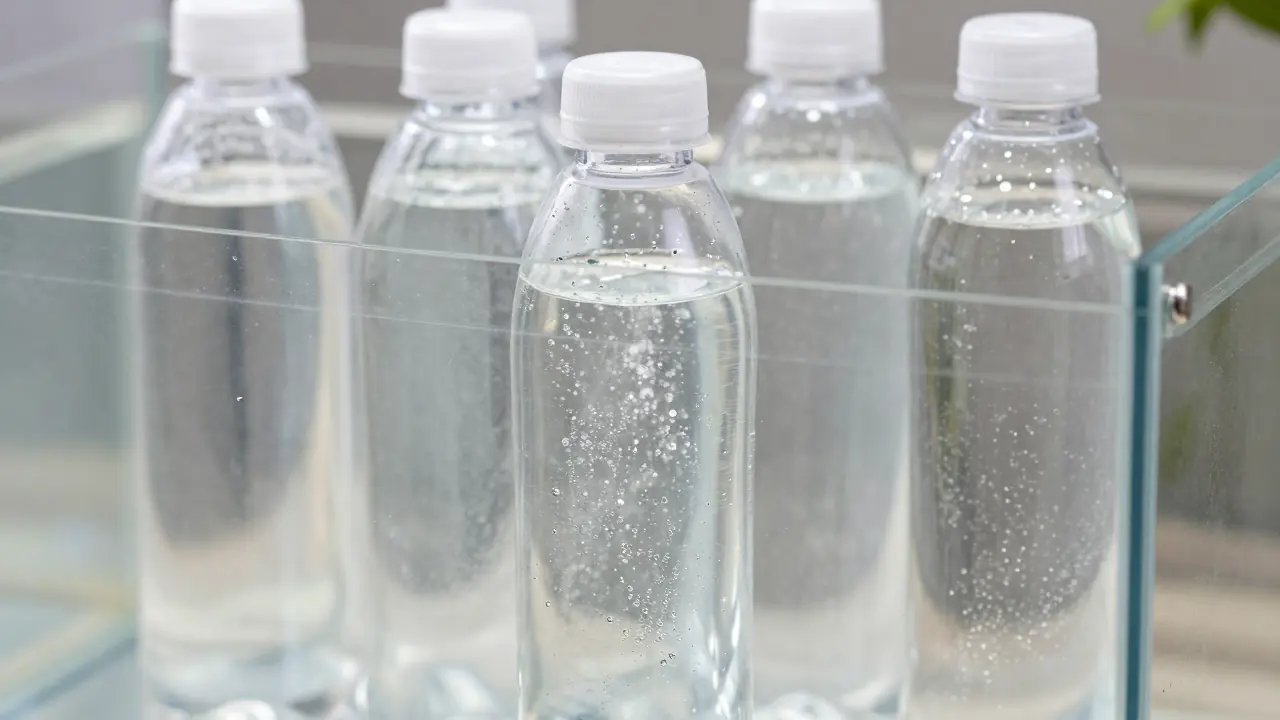
- Do not put a fan next to the water without a drip loop or leave cords where splashes reach them.
Too cold: how to warm a tank
If the tank is below your species range, check that the heater is working, that it is the right size and that the room is not much colder than the tank. Drafts, windows and an air conditioner blowing on the glass all pull heat out. If you have to wait days for a replacement heater, the temperature drop alone can make fish sick, so warm the room and wrap the tank while you wait.
Aquarium heater wattage
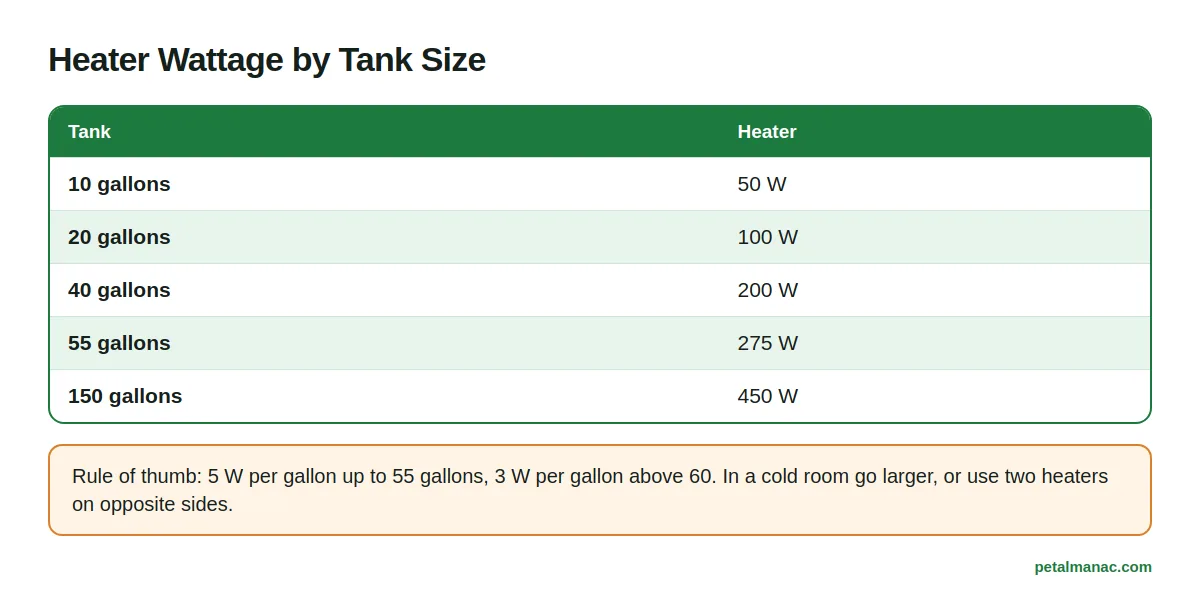
The usual rule is 5 watts per gallon for tanks of 55 gallons or smaller, and 3 watts per gallon for tanks over 60 gallons. Go bigger, or use two heaters, if the room is cold. Two heaters work best placed on opposite sides of the tank.
| Tank size | Rule | Heater watts |
|---|---|---|
| 10 gallons | 5 W per gallon | 50 |
| 20 gallons | 5 W per gallon | 100 |
| 40 gallons | 5 W per gallon | 200 |
| 55 gallons | 5 W per gallon | 275 |
| 150 gallons | 3 W per gallon | 450 |
Total wattage can be split across two heaters. See tank sizes for volumes. An undersized heater can look faulty because it never reaches the setting.
Setting the heater
Most heaters have a dial or attachment at the top. Set it to the temperature your species needs, then watch the thermometer for a day before trusting it. Hang-on models must never be fully submerged, because the top is not waterproof and that risks electrocution.
Heater not working, or stuck on
Do not guess. First check that the heater is plugged in, fully submerged to its marked line (for submersible types) and that the glass is not cracked. When a working heater runs you may hear a faint clicking as the thermostat switches, and the coils glow faintly and the indicator light switches off once the set point is reached.
A heater that never switches off is an emergency. Unplug it immediately and cool the tank slowly using the methods above. A stuck-on heater is a known failure, caused by worn thermostat contacts that stay joined. Plan for it: run the heater through an external temperature controller that cuts power independently, and split the wattage across two smaller heaters, so one failure cannot cook the whole tank. Many keepers replace heaters every few years. Always unplug the heater before draining the tank or putting a hand in, and never run it out of water.
Heaters, chillers and fans are mains equipment sitting next to water. Use UL-listed gear, run heaters through a thermostat or controller, and check temperature with a digital probe thermometer. Make a drip loop in every cord so water runs down away from the outlet, and unplug everything before putting your hands in the tank.
Power outage
A tank loses heat slowly when full and covered. Wrap it in blankets or foam, close the lid and leave the room closed. Run a battery-powered air pump for oxygen. In hot weather, turn off lights and keep the room shaded. When power returns, let the temperature recover on its own.
More step-by-step guides are in our How-To section.
FAQ
Do fish tanks need heaters?
Tropical fish do, because most homes drop below 74°F at some point. Cool-water fish such as common goldfish usually do not.
Can I put ice cubes in the tank?
Only if they are made from dechlorinated or RO water, and sparingly. Sealed frozen bottles are better.
How can I cool a tank without a chiller?
Fans over the surface, lights off, lid off, room cooling and insulation are enough for most tanks.
How much can I drop the temperature at once?
No more than 2 or 3°F in a 4-hour period.

The Pet Almanac editorial team researches, writes and edits every care guide on the site. Each guide is fact-checked before publishing and reviewed again when care guidance or equipment changes.