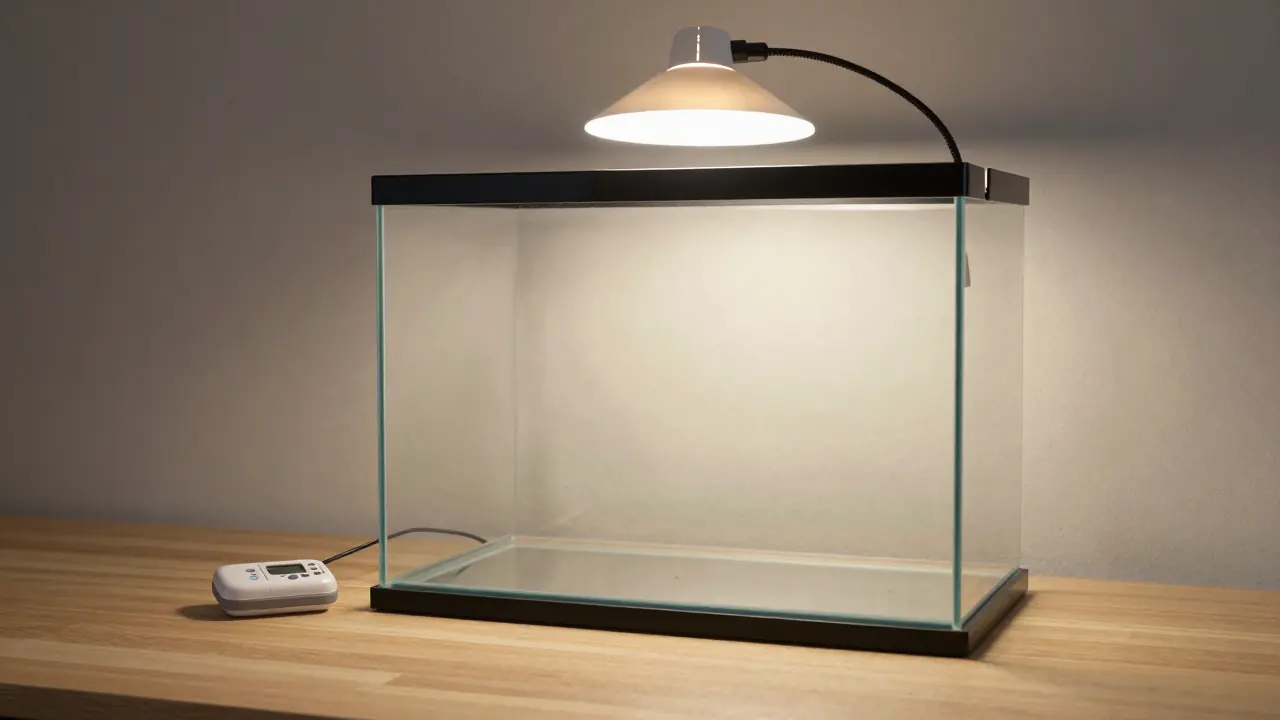
Leopard geckos need a gradient, not one fixed temperature: a basking surface around 94 to 97°F, a warm side near 90°F, a cool end in the 70s, and a nighttime drop that can go as low as 60°F. Daytime heat comes from an overhead lamp or heat source on a thermostat, humidity stays low, and a low-output UVB light is a worthwhile addition.
The numbers below are the working targets, followed by how to hold them with each kind of heater. For the rest of the setup, see our leopard gecko tank setup guide.
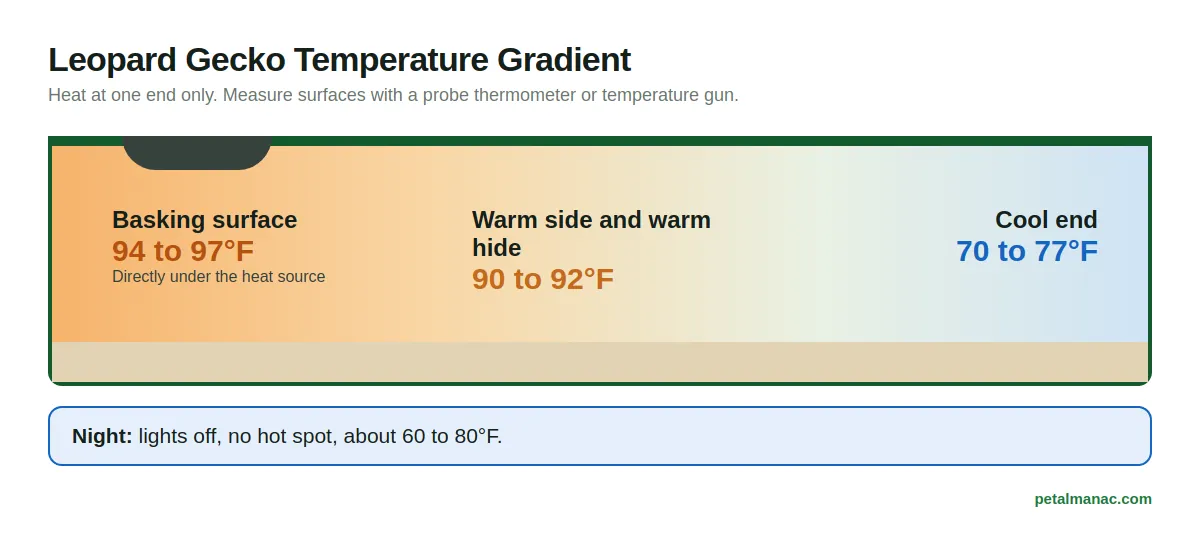
Leopard gecko temperature zones
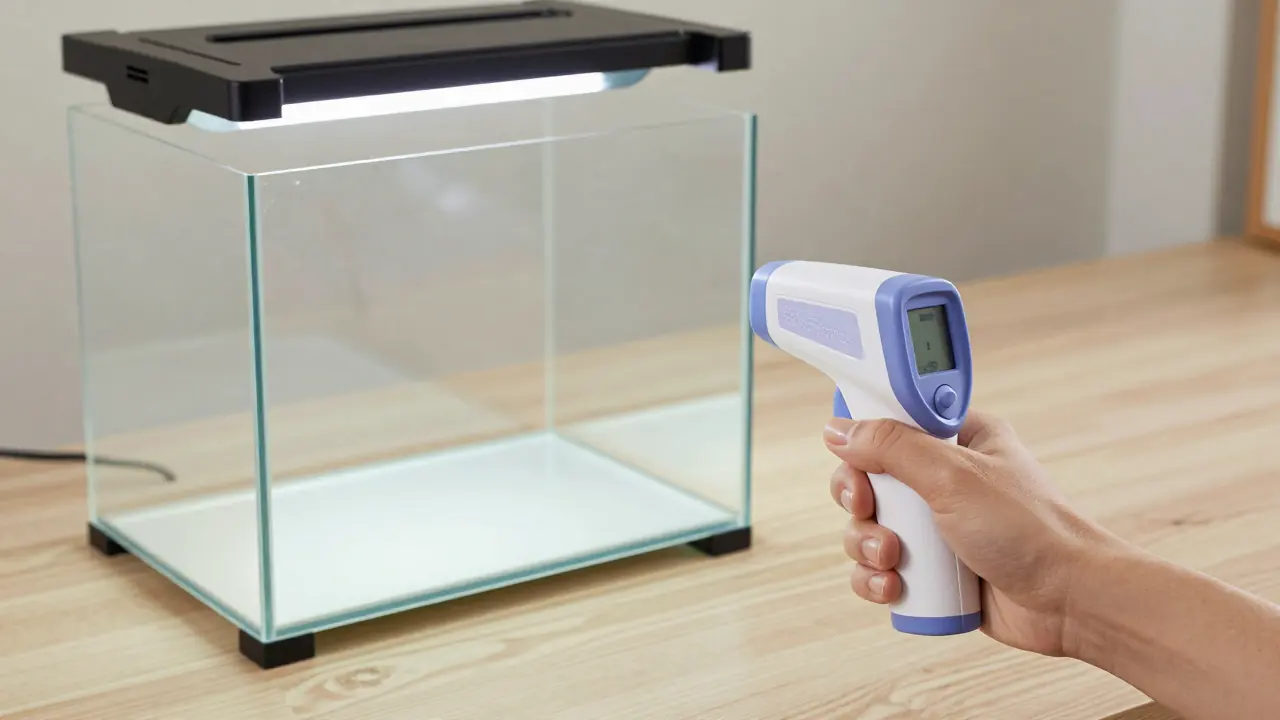
Your gecko is cold-blooded and picks its own body temperature by moving between warm and cool spots. Build a clear gradient so it can do that. Read each zone with a digital probe thermometer or temperature gun at the point where the gecko actually sits, not the air near the lid.
| Zone | Target |
|---|---|
| Basking surface | 94 to 97°F |
| Warm side or warm hide | 90 to 92°F |
| Cool end | 70 to 77°F |
| Night | Lights off, no hot spot, about 60 to 80°F |
A warm side of 87 to 92°F and a cool side up to 85°F also work. Aim for the figures in the table, and keep the cool end from going under 70°F during the day. A gecko with room to choose will settle at a body temperature in the high 70s, so the gradient matters more than any one number.
How cold is too cold?
Below 70°F on the cool end during the day is too cold, and sustained temperatures under about 60°F at night are the limit. When a gecko cannot warm up, its body cannot work normally. If your room drops below that, add heat rather than hoping the gecko adapts.
Is 90 too hot?
No. A reading of 90°F on the warm side is right on target, and a basking surface of 94 to 97°F is normal. What matters is that a cooler zone is available on the other end. Overheating is a risk when there is no gradient, no thermostat or a bulb sits too close, so measure at the floor and at the basking surface, not just the air.
Which heat source should you use?
| Heat source | What it does | Best use |
|---|---|---|
| Halogen or incandescent lamp | Gives off light and heat, mostly shorter infrared | Daytime basking spot, about 50 to 75 W to start |
| Deep heat projector | Gives off heat with little visible light, mostly longer infrared | Day or night heat, needs a proportional (dimming) thermostat |
| Ceramic heat emitter | Gives off heat only, no light | Night heat, since it is lightless |
| Heat mat | Warms the floor under a hide | Supplement, only with a thermostat |
For daytime heat, 50 W halogen is a good starting point, and a spot-style bulb of 75 to 100 W may be needed in a larger or cooler enclosure. Use a well-made dome fixture with a ceramic socket. For night heat, a ceramic emitter is cleaner than any colored bulb: you do not need a black, red or blue night light, and colored bulbs disturb the day and night cycle. A heat mat belongs under the warm hide, covered by about 1 inch of substrate, and only when it is regulated by a thermostat.
Run every heater through a thermostat, buy UL-listed equipment, and check the hot spot with a digital probe thermometer or temperature gun. Heat rocks and unregulated heat mats can burn a gecko. Deep heat projectors need a proportional thermostat. Avoid unknown brands with no safety listing.
Do leopard geckos need a heat lamp 24/7?
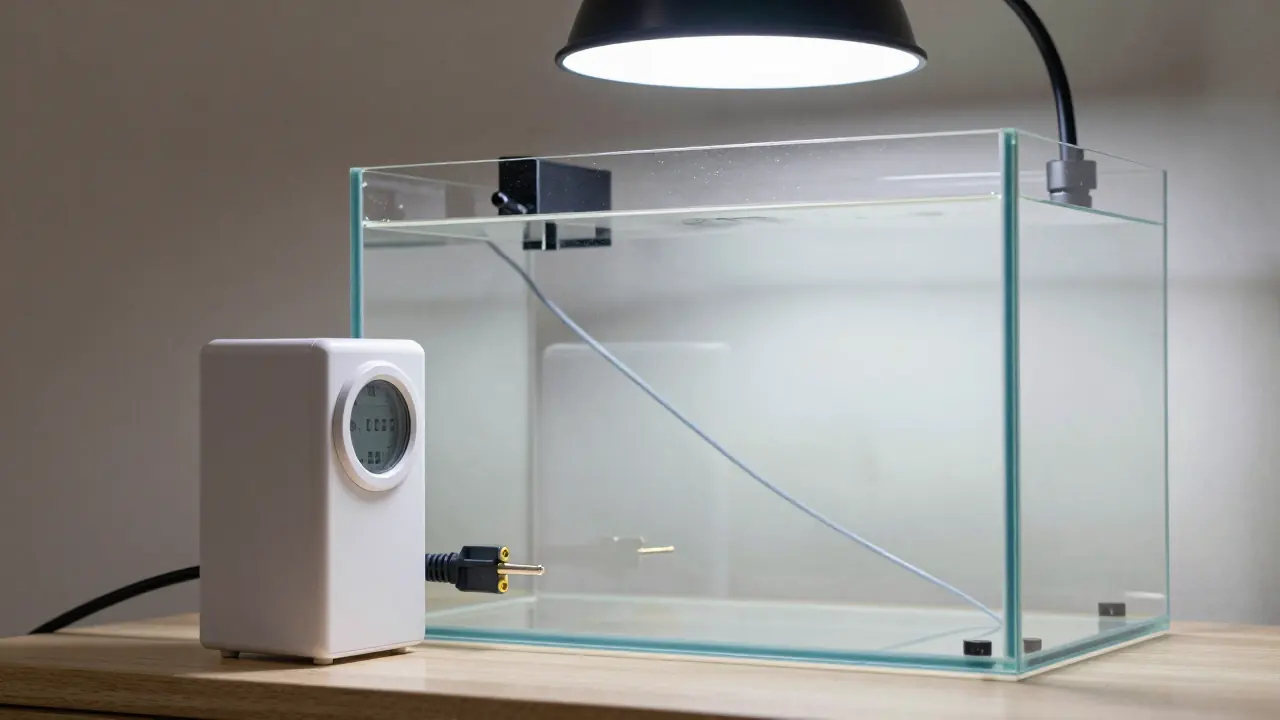
No. Run daytime heat for about 12 hours and switch it off at night. In summer you can stretch the day to about 14 hours of light and heat. A simple timer does this reliably. At night the temperature should drop, with no hot spot. If the room falls below about 60°F overnight, add a lightless ceramic emitter or a thermostat-controlled mat, not a lamp left on.
Do leopard geckos need UVB?
Yes, a low-output UVB light is recommended, though leopard geckos need much less than sun-basking lizards. Aim for a UV Index of roughly 0.5 to 1.5 at the spot where the gecko rests, and keep it lower for pale or hypo morphs, which are more sensitive and can be burned by excess UVB. Put it on a timer, and replace the tube on schedule, because its output fades even while the light still looks bright. Replacement intervals quoted range from 6 months to 12 months depending on the tube. Mount the fixture at the distance the tube maker specifies, and always leave shaded hides so your gecko can step out of the light.
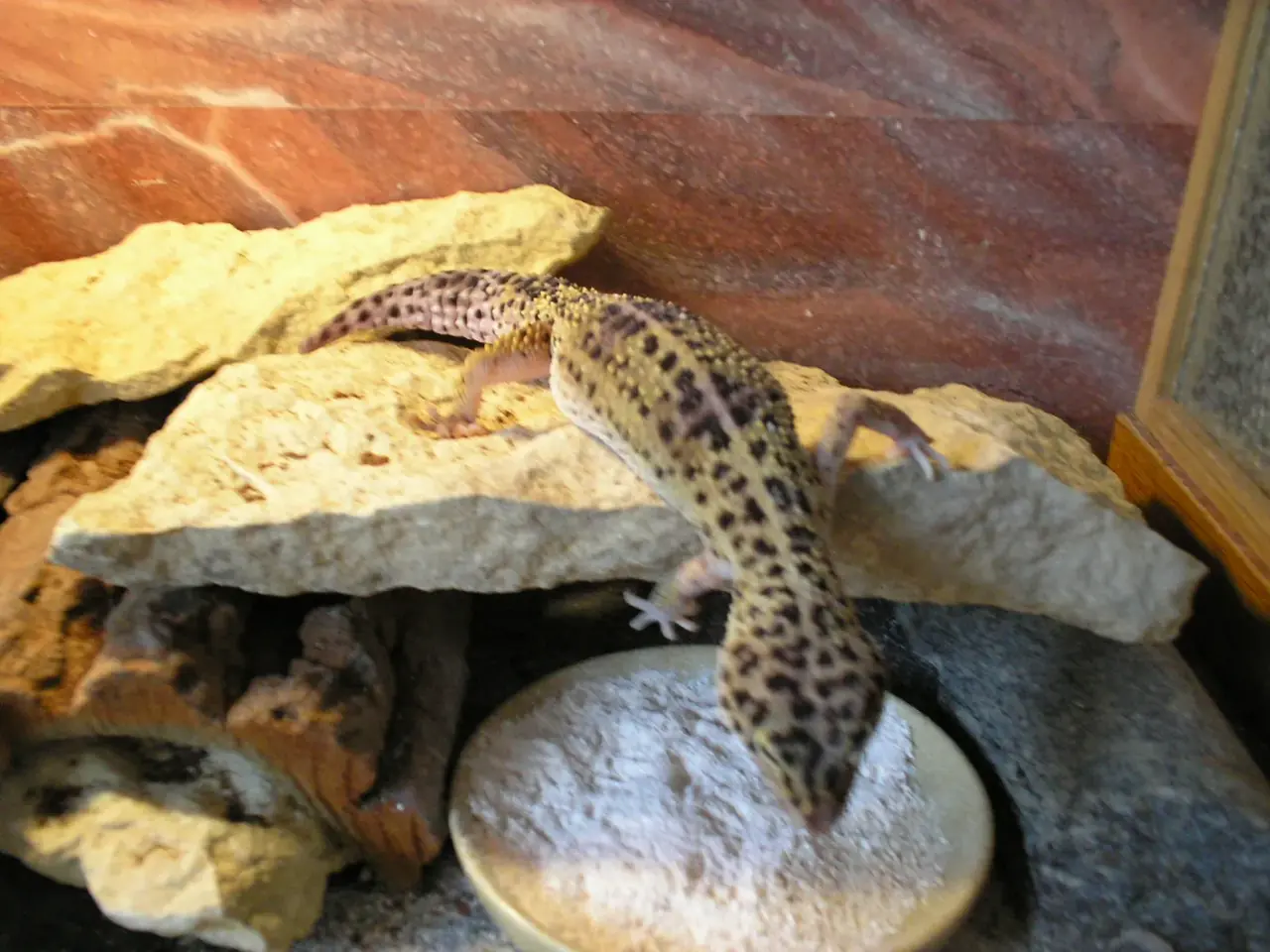
Humidity for leopard geckos
Keep the enclosure dry, about 30 to 40 percent during the day. A humid hide is the exception: it should sit around 70 to 80 percent so your gecko can shed fully. Humidity that is too high or too low causes trouble, and stuck shed is among the most common husbandry problems, so check the humid hide each day. Do not obsess over the room number. A well-kept humid hide matters more than spraying the whole enclosure.
How to set up and check the heat
- Mount the lamp or heater over one end of the enclosure, above the warm hide, never over the cool hide.
- Plug the heater into a thermostat and put the thermostat’s probe at the basking spot or on the floor under the heat source, as the thermostat manual directs.
- Set the thermostat to the basking target, then read the surface with a digital probe thermometer or temperature gun.
- Read the warm hide and the cool hide the same way. Hide interiors should closely match the surrounding area.
- Adjust the bulb height or wattage until all three zones sit in range, then recheck at night with the lamp off.
Recheck after every season change. A room that runs warm in summer may need a lower wattage, and a cold winter room may call for a stronger bulb or a second, lightless heater at night.
A daily lighting and heating schedule
- Switch on the daytime heat in the morning, around sunrise
- Run the visible light for about 12 hours (up to 14 in summer)
- Run the UVB on a timer during the day
- Switch daytime heat off in the evening and let temperatures fall
- Use only a lightless emitter or thermostat-controlled mat if the room is too cold at night
Leopard gecko heat and lighting FAQ
How cold is too cold?
Under 70°F on the cool end in the day, or well under 60°F at night, is too cold. Add controlled heat.
Is 90 too hot?
No. 90°F on the warm side is a good target, as long as a cooler end is available.
Do leopard geckos need a heat lamp 24/7?
No. Run heat about 12 hours a day and let the enclosure cool at night.
Get the gradient right first and the rest of leopard gecko keeping becomes much simpler. The leopard gecko care guide pulls the whole routine together, and what leopard geckos eat covers feeding, which depends on a warm enough gecko to digest properly. More guides live in the reptiles section.

The Pet Almanac editorial team researches, writes and edits every care guide on the site. Each guide is fact-checked before publishing and reviewed again when care guidance or equipment changes.