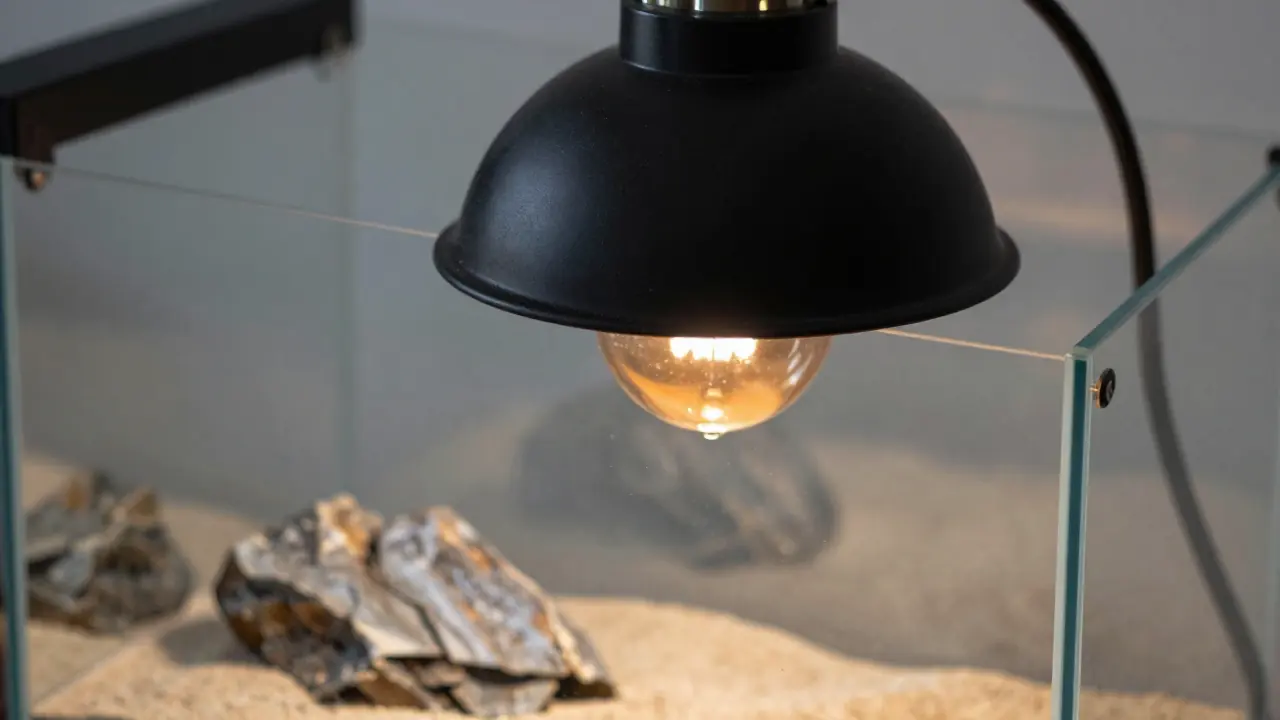
Good reptile heating comes down to three things: a warm basking spot at one end, a cooler zone at the other, and every heater plugged into a thermostat. Pick the heat source that matches your enclosure and species, control it with the right type of thermostat, and check the result with a digital probe thermometer and an infrared temperature gun instead of guessing.
This guide explains how each heat source works, which thermostat goes with which, how to measure, and what to do when the enclosure runs too hot, too cold, or the heat mat stops working. Species-specific targets live on the care pages, such as our leopard gecko heat and lighting guide. More step-by-step help is collected in our How-To section.
Run every heat source through a thermostat, and check temperatures with a digital probe thermometer or an infrared temperature gun, never by hand or by feel. Buy UL-listed equipment, use a ceramic socket rated for the bulb wattage, keep the thermostat rating at or above the heater wattage, and keep cords and any water bowls apart. Unplug equipment before reaching into the enclosure. This guide covers husbandry, not medical care: a reptile that stops eating, hides constantly or seems unwell needs an exotic veterinarian.
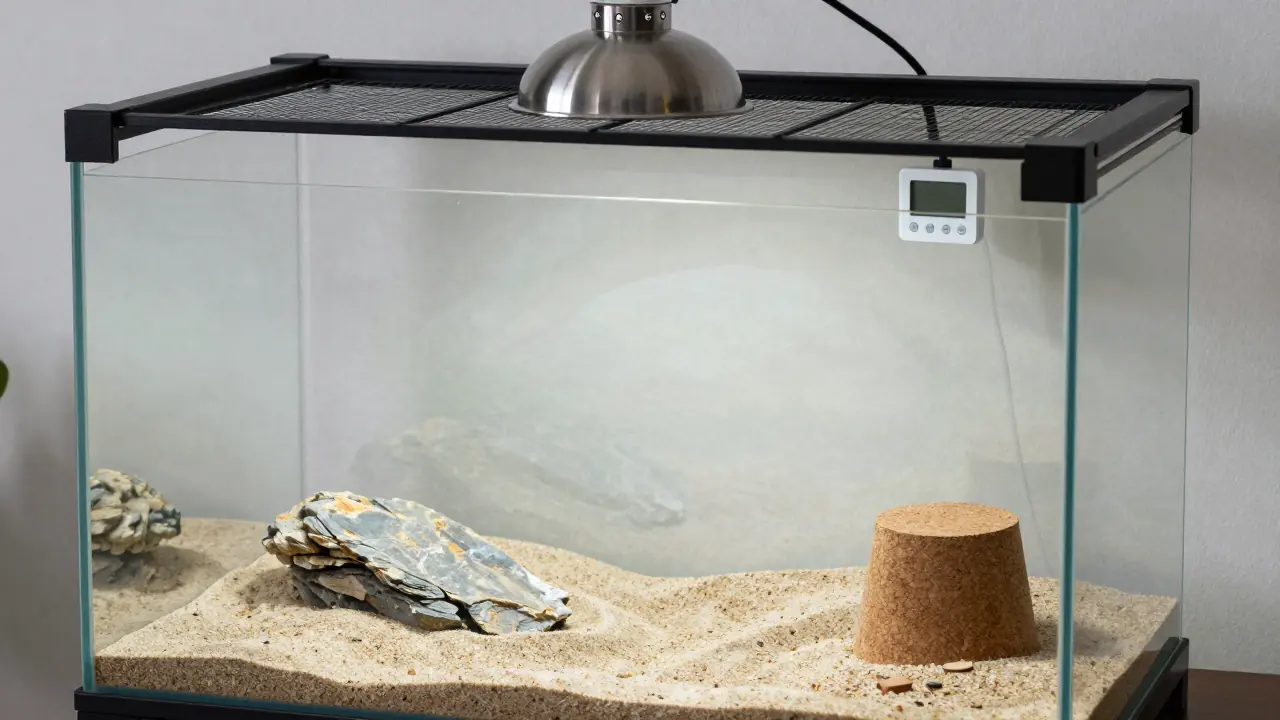
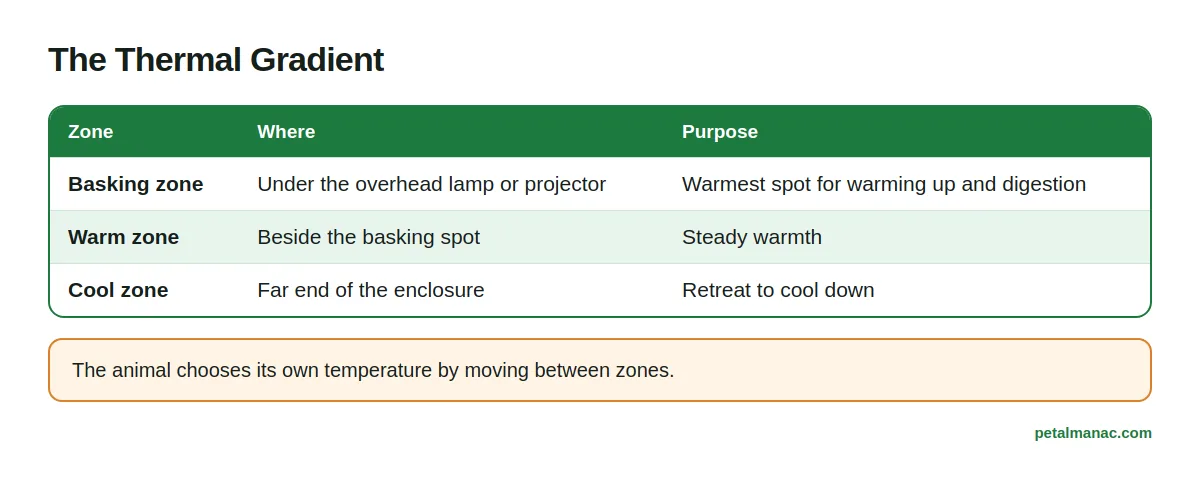
The thermal gradient: why one temperature is never the goal
A reptile cannot make its own body heat, so it moves between warm and cool spots to set its temperature. Your job is to build that choice into the enclosure: a basking zone that is the warmest area, a warm zone beside it, and a cool zone to retreat to. A single even temperature across the whole tank takes that choice away, and even a perfect number is wrong if the animal cannot get away from it.
Basking heat and ambient heat are two different jobs. Basking heat is a localized, intense patch of radiant warmth that the animal sits in. Ambient heat is the background air temperature of the enclosure. Lamps mainly create basking spots, while heat emitters and panels mainly raise the background. Most setups need the first, and some need both.
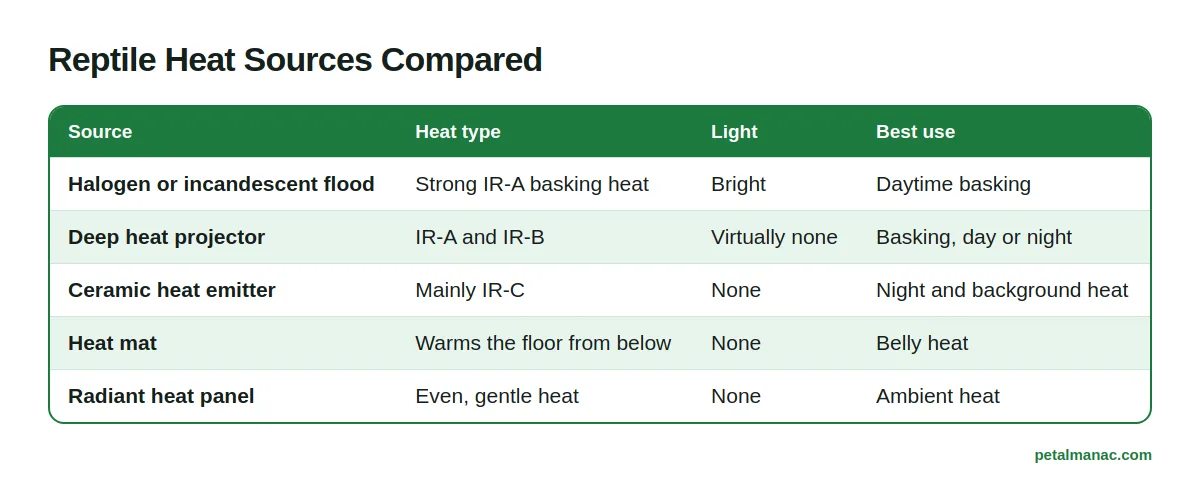
Reptile heat sources compared
| Heat source | What it does | Light | Typical use |
|---|---|---|---|
| Halogen or incandescent flood lamp | Strong basking heat, mostly short-wave infrared (IR-A) | Bright visible light | Daytime basking spot only |
| Deep heat projector | Infrared-A and infrared-B heat | Virtually none | Basking heat, day and night |
| Ceramic heat emitter | Mainly infrared-C, which warms the air more than the animal | None | Night and background heat |
| Heat mat or under-tank heater | Warms the floor from below | None | Snake racks, hatchlings, some geckos |
| Radiant heat panel | Even, gentle heat from above | None | Popular with snake keepers |
Halogen and incandescent lamps
These give the brightest, most sun-like basking spot, and they double as daytime light. Because they shine, they belong on the daytime schedule only. Use a dimming thermostat so the bulb is never switched hard on and off, and a dome fixture with a ceramic socket.
Deep heat projectors
A deep heat projector looks like a bulb but gives off heat with almost no visible light, so it can run through the night without disturbing the day and night cycle. It projects infrared-A and infrared-B, the wavelengths that reach below the skin surface, and the wide beam is less likely to create a dangerously hot pinpoint than a tight-beam lamp. Common wattages run from 50 W up to 150 W, and the bulbs fit a standard lightbulb socket. A lower-wattage projector can do the work of a higher-wattage ceramic emitter because less of its heat is wasted.
Output depends strongly on distance. As a rough guide, a 50 W projector measured about 131°F at 6 inches, 113°F at 8 inches, 97°F at 12 inches and 84°F at 16 inches, while an 80 W unit read about 144°F, 124°F, 111°F and 97°F at the same distances. Treat these as ballpark figures: room temperature and enclosure design shift them, which is why you set the height by measuring the basking surface, not by trusting a chart.
Ceramic heat emitters
A ceramic heat emitter produces heat and no light, which makes it the usual choice for keeping an enclosure warm after the lights go off. It radiates mostly infrared-C, so it warms the air and the surfaces around it rather than the animal itself. Common wattages are 50, 60, 80, 100 and 150 W. We cover sizing and fixtures on the separate ceramic heat emitter page.
Heat mats and under-tank heaters
A heat mat warms the floor beneath a hide, which suits snakes in racks, hatchlings and some geckos. It is simple and cheap to run, but it only warms what sits directly on it, it does little for the air, and it should never run without a thermostat. Cover only part of the floor so there is always a cool area.
Radiant heat panels
A radiant panel hangs overhead and gives even, flat heat with no light and no hot spot. It is a good background heater for larger enclosures and rack setups, usually with a thermostat of its own.
Which thermostat for which heater
A thermostat reads a probe and controls the heater to hold your set temperature. There are three types, and the wrong pairing is a common cause of burnt-out bulbs and poor control.
| Thermostat | How it controls heat | Use with | Avoid with |
|---|---|---|---|
| On/off | Switches the heater fully on, then fully off | Heat mats, heat cables, ceramic emitters | Light-emitting bulbs |
| Pulse proportional | Sends short pulses of power, adjusting the pulse rate | Ceramic emitters, heat mats, heat cables | Glass bulbs and any light-emitting source |
| Dimming | Lowers and raises the power sent to the heater | Halogen bulbs, deep heat projectors, basking lamps | Heat mats and other non-light devices |
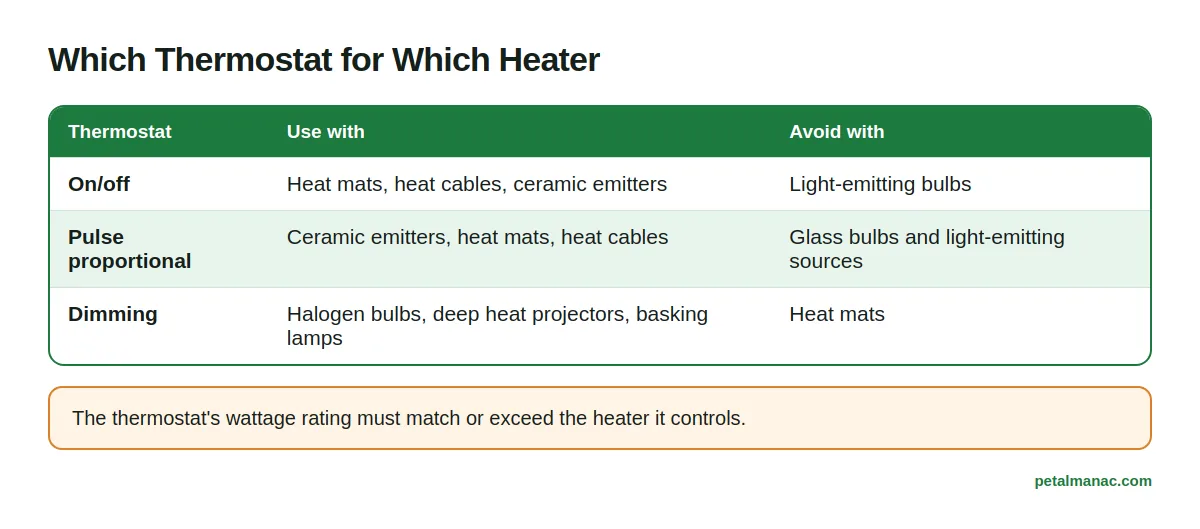
On/off units are cheap but slow to correct, so the temperature can drift a couple of degrees either side of the set point. Pulse proportional units hold steadier temperatures. Dimming units are gentlest on a bulb filament and give smooth control, but they are not the right match for heat mats. For a ceramic emitter, either on/off, pulse or dimming can work, and keepers split on which is best. Always check the thermostat wattage rating: it must match or exceed the heater. Many on/off models are limited to 100 or 300 W, while pulse and dimming models commonly go higher.
Where the probe goes
For a heat mat, place the probe directly on top of the mat, under the hide or substrate where the animal will lie. For an overhead lamp or emitter, hang the probe low in the enclosure, just beneath the heat source, at about the height of the animal when it is basking. Fix the probe so it cannot be moved, buried or chewed, because a displaced probe makes the thermostat heat too much or too little. Set the thermostat to the temperature you want at the warm spot, then watch the first few cycles to make sure it switches on and off properly, and run the whole setup for 24 to 48 hours before the animal goes in.
How to measure reptile temperatures
Use two tools, because each one measures something different. A digital probe thermometer reads the air temperature at the spot where the probe sits, and a model with min-max memory records overnight lows and daytime peaks you would miss between checks. An infrared temperature gun reads surface temperature, which is what the animal actually touches when it sits on a basking rock or the floor.
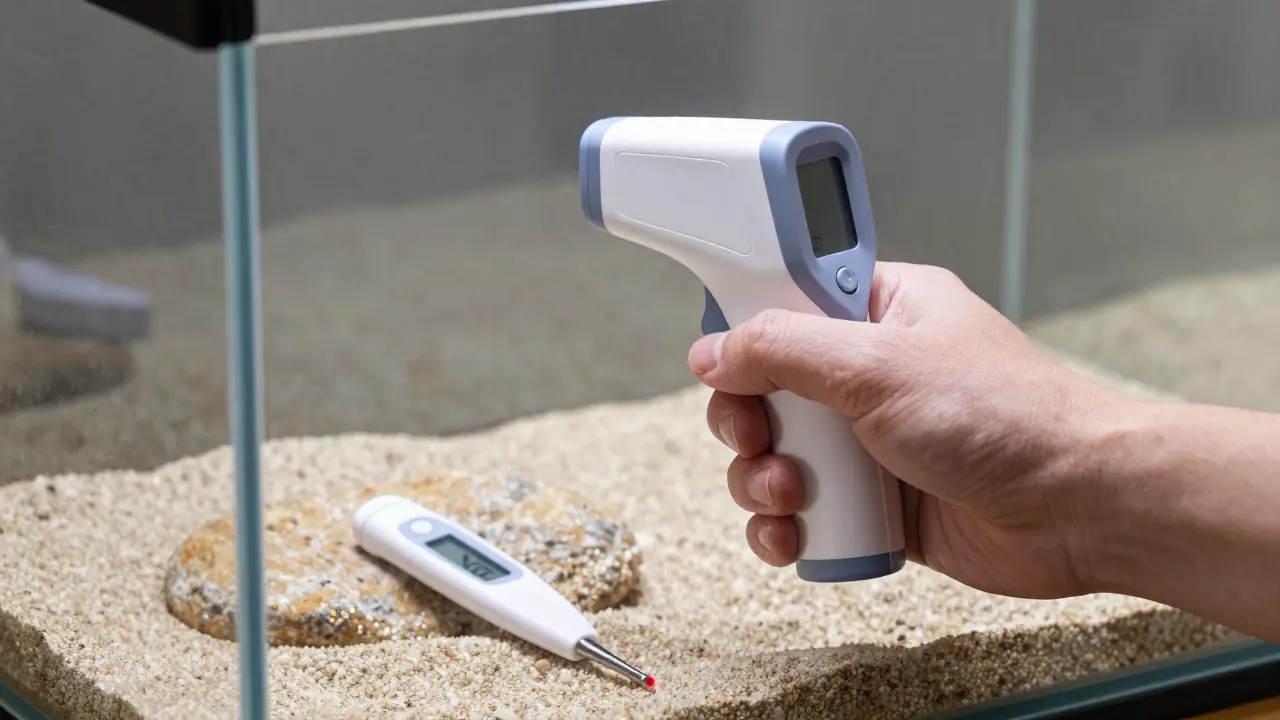
Check the basking surface with the gun rather than the air above it, aiming from about 6 to 12 inches away. Pick a gun that lists an accuracy of 2°F or better: cheap unbranded guns can be off by roughly 5°F, enough to matter when a basking range is narrow. Avoid relying only on analog dial thermometers, which can be inaccurate. Cross-check the probe against the gun now and then, since the two will not always agree.
Keeping the enclosure warm at night
Many species handle or even benefit from a natural overnight drop, but some tropical species need supplemental night heat. Check what your species needs before adding any. If it does, use a source with no visible light: a ceramic heat emitter or a deep heat projector on its own thermostat, or a heat mat or radiant panel. Avoid colored night bulbs, because they still give off light. For a house that runs cold in winter, a night source on a thermostat is far safer than raising the room temperature or leaving a daytime lamp on.
Troubleshooting heat problems
| Problem | Likely causes | What to do |
|---|---|---|
| Reptile tank too hot | Bulb too close, wattage too high, no thermostat, probe in the wrong spot, poor ventilation around the equipment | Raise the fixture or drop to a lower wattage, check the basking surface with a gun, move the probe to the right height, and keep ventilation clear |
| Tank too cold | Wattage too low, set point too low, heat source too far away, cold room, mesh lid losing heat | Lower the fixture slightly or add a night source, raise the set point, and cover part of the lid if the species allows |
| Heat mat not working | Plugged into the wall instead of the thermostat, thermostat set too low, probe off the mat, cracked or failed mat, faulty thermostat | Check the plug and breaker, confirm the probe sits on the mat, and replace a damaged mat instead of repairing it |
| Thermostat reading does not match the gun | Probe measures air, gun measures surface | Trust the gun for surface checks, adjust the set point, and confirm with a second thermometer |
Overheating is more dangerous than being a little cool, so make changes in small steps and re-read the temperatures after each one. Check temperatures first whenever a reptile seems off, and bring in a veterinarian if the behavior does not settle.
UVB basics
Most diurnal reptiles do better with UVB light, which is a separate job from heat. Reptiles fall into four UV Index zones that run from shade dwellers to midday sun baskers. The all-day average UV Index for each is roughly 0.1 to 0.7 for zone 1, 0.7 to 1.0 for zone 2, 1.0 to 2.6 for zone 3 and 2.6 to 3.5 for zone 4. These are averages, not maximums.
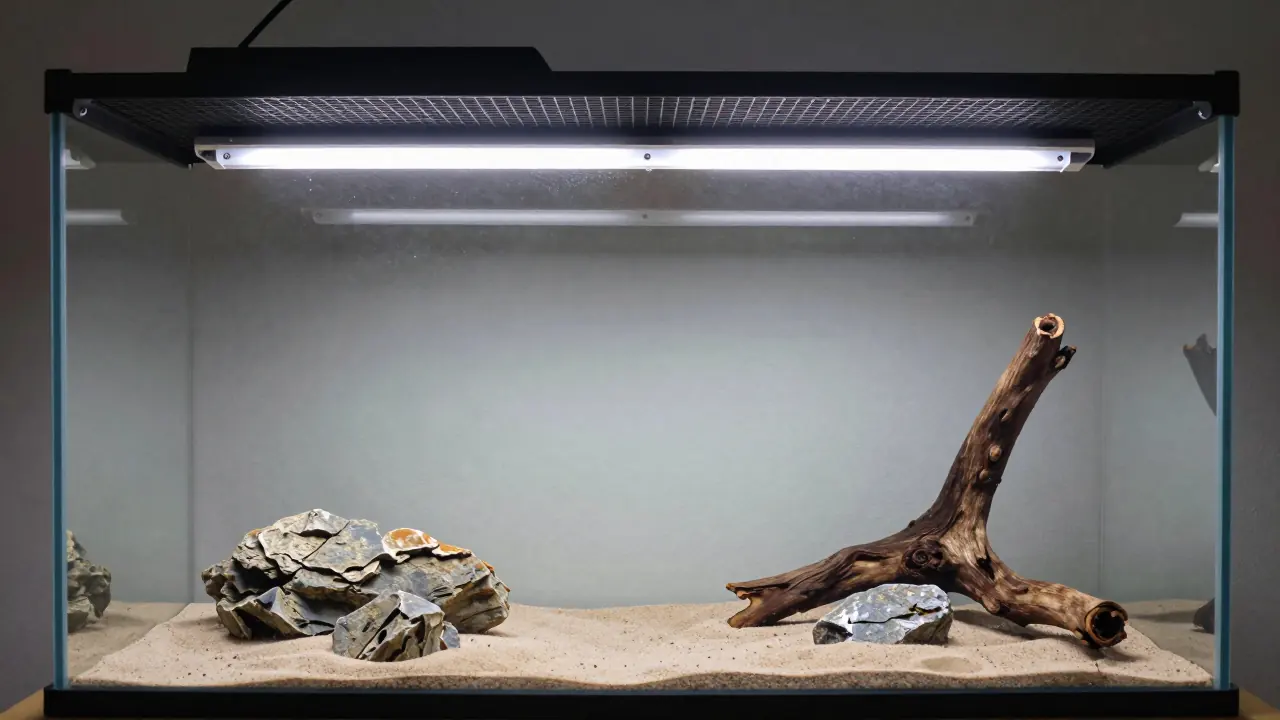
- T5 vs T8: T8 tubes are older technology and produce weaker UVB. T5 HO (high output) tubes are stronger and penetrate further into the enclosure, so they suit taller setups.
- Distance: UVB strength falls as distance grows, so the closer the animal sits, the stronger the dose. Follow the distance printed on the packaging for your tube, then adjust to your species’ zone.
- Mesh: mesh blocks a significant amount of UVB, so mount the fixture beneath the mesh, not above it.
- Replacement: UVB output declines until the tube is just an ordinary light. Replace on the manufacturer schedule, usually every 6 to 12 months, and write the purchase date on the tube. A bright tube is not proof it still works.
For gecko-specific lighting, see our leopard gecko tank setup page.
Questions keepers ask
What is the best way to heat a reptile tank?
Use an overhead basking source on a thermostat for species that bask, plus a lightless night source if the room gets too cold. Add a thermometer at each end and check the basking surface with a gun.
How do I keep a reptile warm if the power goes out?
Insulate the enclosure by covering the sides and part of the lid, keep it closed, and move it to the warmest interior room. Never use a stove, open flame or unmanaged heater to bridge an outage. If it lasts long, call an exotic veterinarian for advice.
Can I use my heat mat thermostat for a deep heat projector?
Usually not. A deep heat projector heats through a glass bulb, so it needs a dimming thermostat, not an on/off or pulse model.

The Pet Almanac editorial team researches, writes and edits every care guide on the site. Each guide is fact-checked before publishing and reviewed again when care guidance or equipment changes.