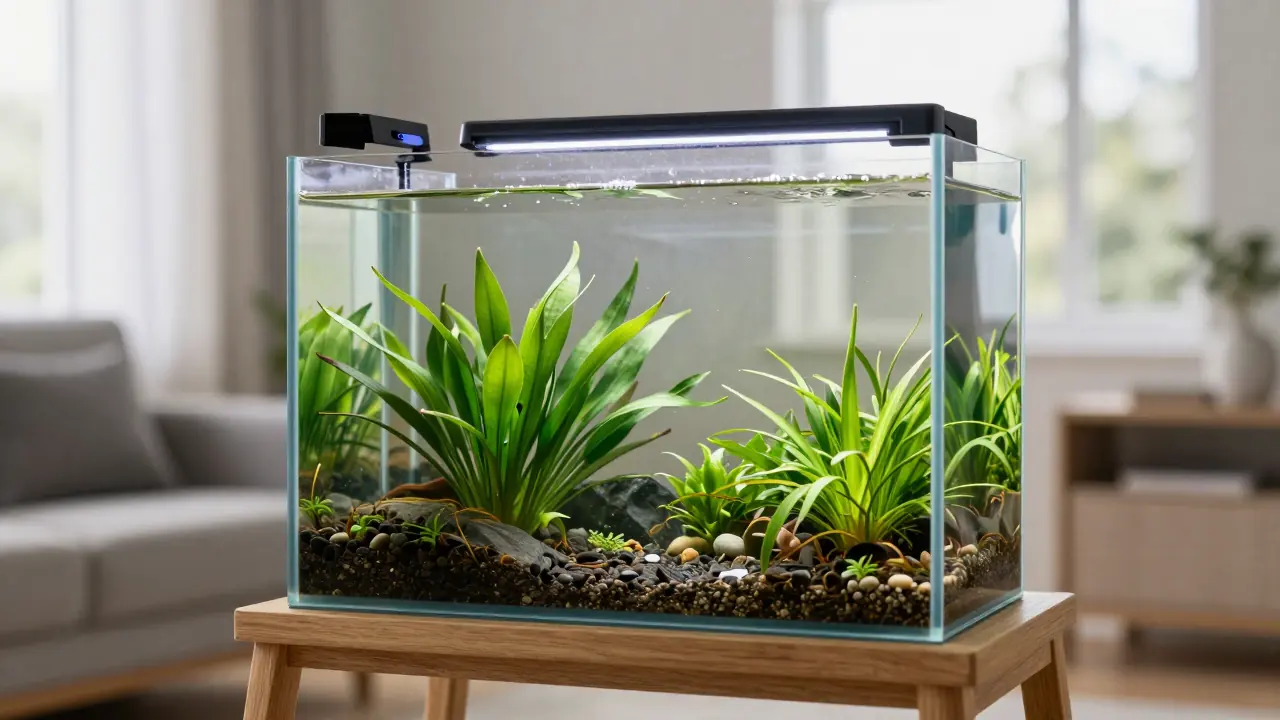
To lower ammonia in a fish tank, change 25 to 50% of the water with dechlorinated water, stop feeding for a day, and make sure the filter is running. Then find out why ammonia built up, because the water change only buys time. The goal reading is zero.
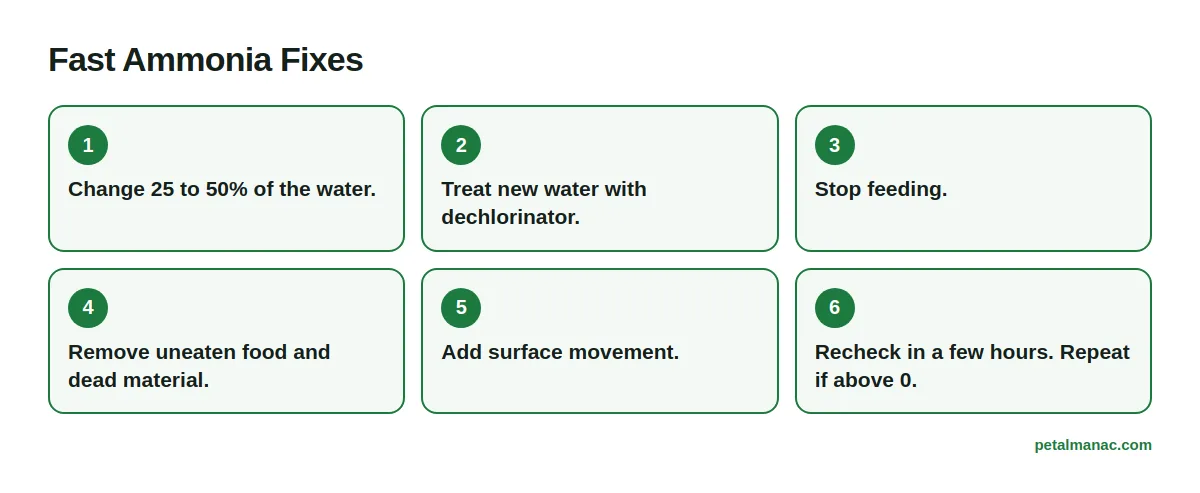
Fast fixes for the next hour
Work through these in order. Each one is quick, and together they usually bring a reading down within a day.
- Change 25 to 50% of the water. Use a gravel vacuum so you pull waste from the substrate while you drain. Some guides allow up to 50%, and 25% is plenty for a mild reading. Take more out if the reading is high or the fish look distressed.
- Treat the new water with dechlorinator first. Tap water chlorine and chloramine kill the bacteria that remove ammonia, so never pour untreated water into a tank that is already struggling. Our guide to aquarium water conditioners explains which kind to pick.
- Stop feeding. Fish can go a couple of days without food, and every meal adds more ammonia from waste. Skip feeding until the reading is back to zero, then resume small meals.
- Remove uneaten food and anything dead. Look under decor, inside plants and behind the filter for a dead fish, snail or rotting leaves.
- Add oxygen. Point the filter outlet at the surface or add an air stone. Warm, ammonia-rich water holds little oxygen.
- Recheck in a few hours. Repeat the water change if the reading has not dropped.
If you need relief fast, an ammonia-binding conditioner can neutralize ammonia temporarily. It does not remove it, and some of these products can lower dissolved oxygen, so run extra surface movement and use the dose printed on the bottle.
In an emergency, you can also lower the temperature by a couple of degrees, since cooler water slows the shift toward the more toxic form of ammonia. Do it gradually and only a couple of degrees.
Find out why ammonia is high
A reading above zero means ammonia is being produced faster than your filter bacteria can process it. One of these is almost always the reason.
- The tank is new or not cycled. Without a bacterial colony, ammonia from fish waste has nowhere to go. See the section below and our fish tank cycling guide.
- Overfeeding. Food that sinks uneaten rots into ammonia. Feed only what the fish finish in about 1 to 3 minutes.
- A dead fish, snail or decaying plant. Even a small body decomposing in a corner can spike the reading.
- Overstocking. More fish means more waste. Heavy waste producers such as oscars and goldfish need far more filtration and water changes than their size suggests. Check tank sizes before you add more fish.
- A filter that is too dirty or cleaned too hard. A clogged filter stops moving water, and scrubbing media under the tap strips away the bacteria. Rinse media gently in old tank water, never in chlorinated tap water, and never replace all of it at once.
- Medications or untreated tap water. Some medications and chlorine in tap water can kill filter bacteria, which lets ammonia climb. If you have just medicated, watch ammonia daily.
- High pH and warm water. The same ammonia reading is more dangerous in warm, higher pH water, covered below.
What ammonia, nitrite and nitrate readings should be
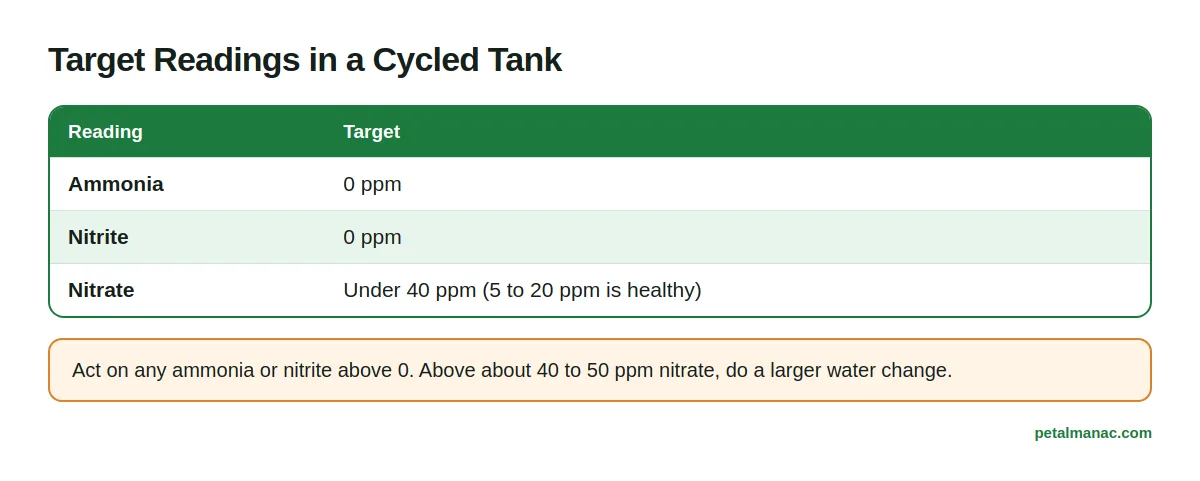
The target for ammonia and nitrite in an established aquarium is 0 ppm. Nitrate is far less toxic, but it builds up unless you change water.
| Compound | Target in a cycled tank | Act when |
|---|---|---|
| Ammonia | 0 ppm | Any reading above zero. Even 0.25 ppm can stress sensitive fish. |
| Nitrite | 0 ppm | Any reading above zero. Do a water change and go easy on filter cleaning. |
| Nitrate | Under 40 ppm (5 to 20 ppm is a healthy range) | Above about 40 to 50 ppm, do a larger water change and recheck stocking. |
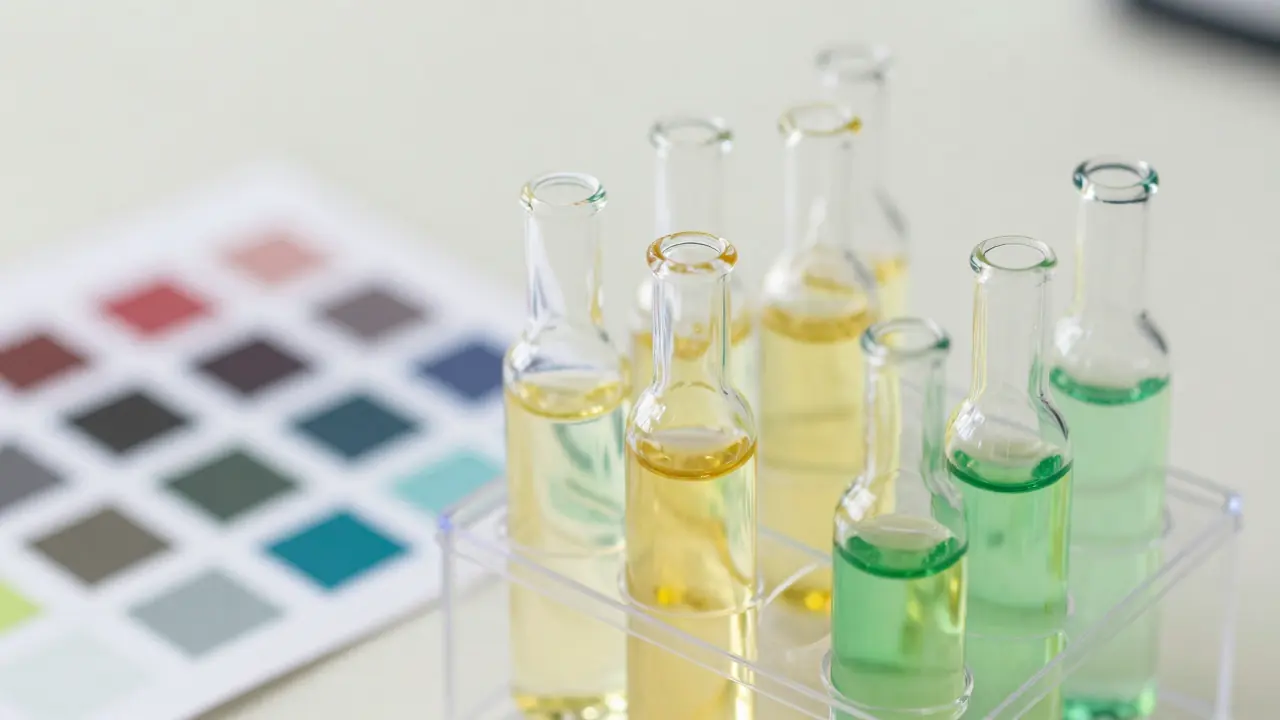
Read your tank weekly with a liquid water-parameter kit, and read it right away if fish look unwell. Kits expire, so check the date. Strips are quicker, and liquid kits are easier to read at low levels.
Ammonia vs. ammonium, and why pH and temperature matter
Dissolved ammonia exists in two forms: un-ionized ammonia (NH3), which is the toxic one, and ammonium (NH4+), which is far less harmful. Many kits report total ammonia, meaning both forms added together. The share of toxic NH3 rises as pH and temperature rise. In acidic water, more of the total is ammonium and the same reading is less dangerous.
That is why a reading of 0.5 ppm in a warm tank with a pH of 8 is a bigger emergency than the same reading in a cool, slightly acidic tank. It does not make a low-pH tank safe, so treat any reading as a problem. One caution: do not try to fix ammonia by pushing pH down quickly. Swings stress fish, and low pH slows filter bacteria. Lower ammonia first and adjust pH slowly later, using our guide to lowering pH if you need to.
How long until ammonia drops?
In a cycled tank, a water change and a feeding pause usually bring ammonia to zero within a day or two. Recheck every few hours at first. If the reading stays up after two or three water changes, the problem is the source, not the water: a dead animal, a failed filter or an uncycled tank.
In a new tank the clock is different. Bacteria take weeks to establish, and ammonia will keep returning until they do. That timeline depends on temperature, bioload and the filter, so we do not put a single number on it.
Ammonia spike in a new tank
A spike in the first weeks is normal, not a failure. The bacteria that turn ammonia into nitrite, and then nitrite into nitrate, take time to grow. Until both groups are established, ammonia and nitrite appear in sequence.
- Run the filter around the clock. Turning it off starves the bacteria of oxygen and water flow.
- Read ammonia and nitrite every day or two, and do a 25 to 50% water change when either is above zero while fish are in the tank.
- Feed very lightly during this period.
- Read the whole process in our cycling guide. A fishless cycle is done when added ammonia reads zero ammonia and zero nitrite a day later.
Natural ways to keep ammonia low
- Feed less. Overfeeding is the most common avoidable cause.
- Stock fewer fish. Thinning out a crowded tank directly reduces the ammonia produced.
- Add live plants. Plants absorb ammonia, mostly as ammonium, directly from the water as a nutrient. Fast-growing species with strong lighting take up the most. See easy aquarium plants.
- Maintain the filter. Give it enough capacity for the bioload, and rinse media in tank water on a schedule. Our filter types guide compares options.
- Keep up with water changes. A routine from the tank cleaning guide removes waste before it turns into ammonia.
High nitrates in a fish tank
Nitrate is the end product of the cycle, so it rises steadily in a healthy tank. Readings under 40 ppm suit most freshwater fish. If nitrate creeps above about 40 to 50 ppm, do a larger water change and recheck your stocking and feeding. Very high readings, above 80 to 100 ppm, can stress fish. Live plants and regular gravel vacuuming keep nitrate down over time. Old tanks that have gone months without a water change can reach very high nitrate, and the fix there is a series of large changes rather than one drastic swap.
Browse more step-by-step fixes in our How-To section.
FAQ
How do I lower ammonia without a water change?
You can reduce toxicity temporarily with an ammonia-binding conditioner, extra aeration and by stopping feeding. These do not remove ammonia, so schedule the water change as soon as you can.
Does a dechlorinator lower ammonia?
Standard dechlorinator removes chlorine. Some conditioners also bind ammonia temporarily. Read the product label to see which yours does.
Is 0.25 ppm ammonia dangerous?
It can stress sensitive fish, and the target is always zero. Do a water change and find the cause.
Can plants alone fix an ammonia problem?
No. Plants help over time but cannot keep up with a spike. Use water changes first.

The Pet Almanac editorial team researches, writes and edits every care guide on the site. Each guide is fact-checked before publishing and reviewed again when care guidance or equipment changes.